



How to Sell Shopify Bundles on TikTok: The Complete 2026 Guide
Learn how to sell Shopify bundles on TikTok Shop with Simple Bundles. Complete 2026 guide.
Basil Khan
Mar 23, 2026 · 6 min
Every completed checkout is a data point showing what your customers actually want to buy together.

Basil Khan
Mar 23, 2026 · 6 min
Basil is the Co-Founder and CTO of Simple Bundles, where he leads product strategy and development. With deep experience building scalable systems for merchants, he specializes in the technical and operational challenges for back-office operations.
You’re already aware, but we’ll say it again because sometimes repetition makes an idea stick:
Strong product bundling strategies are one of the most reliable ways to increase sales while improving profitability. That’s because bundles increase average order value, move slow inventory, and give customers a reason to buy more in a single transaction.
But when you sit down to actually create one, you hit the wall. Which products should you bundle together?
You have 200 SKUs. Maybe 500. The number of possible product combinations is absurd. You could spend hours in a spreadsheet trying to figure out which products get purchased together most often. Or you could guess based on what seems logical. Neither approach feels great, and neither helps you truly optimize your merchandising.
Luckily, your order history already contains the answer. Every completed checkout is a data point showing what your customers actually want to buy together.
You might think your best-selling serum should be bundled with your moisturizer. Makes sense, right? They're both skincare, they're both popular, customers probably use them together. But "probably" isn't a strong foundation for a merchandising decision.
What if your actual sales data shows that customers who buy the serum tend to add the eye cream instead? What if there's a combo you never considered that appears in 30% of your multi-item orders?
Gut instinct works sometimes. But as your catalog grows, so does the gap between what you think customers want and what they actually buy. And that gap hurts conversion rates, limits revenue growth, and weakens your overall marketing strategy.
The spreadsheet approach isn't much better.
Exporting order data, running pivot tables, and manually identifying patterns takes hours. Even then, you're only seeing strict co-purchase relationships like frequently bought together items. You might miss complementary products that make sense but don't appear together often enough to show up in your analysis.
Your order history is the most honest feedback you'll ever get. Customers vote with their wallets.
Every order that includes multiple products is a signal about what goes together in the minds of real buyers, and reflects real customer behavior.
This matters more than product adjacency. More than category logic. More than what you think should sell together based on how you've organized your store.
A coffee roaster might assume their light roast and dark roast should be bundled as a "variety pack." But the order data might show that customers who buy light roast consistently add the vanilla flavored option.
That’s a better cross-sell opportunity, and a smarter upsell when positioned correctly.
Purchase patterns also reveal price sensitivity. If customers frequently buy your $45 product alongside your $22 product, that's a signal about the total cart value they're comfortable with.
A bundle priced at $60 for both increases perceived savings and perceived value, especially when framed as a discounted price compared to buying individual items.
Understanding this helps you build smarter pricing strategy, improve bundle pricing, and deliver bundles that align with real customer needs and customer preferences.
The challenge has always been accessing this information efficiently. That's where Bundle Magic comes in.
Bundle Magic is a Simple Bundles feature that does the spreadsheet work for you. It analyzes your order history using ai-powered algorithms and generates bundle suggestions based on actual purchase patterns.
But it goes beyond simple "frequently bought together" logic. The AI applies intelligence about sensible product combinations, factoring in customer segments, customer behavior, and even indirect relationships between related items.
This means you might see suggestions for complementary items that don’t always appear together but make sense based on broader patterns in your store.
When Bundle Magic generates a suggestion, it doesn't just tell you what to bundle. It creates a complete Shopify product for you:
This is automated bundling designed to streamline your workflow and improve your customer experience.
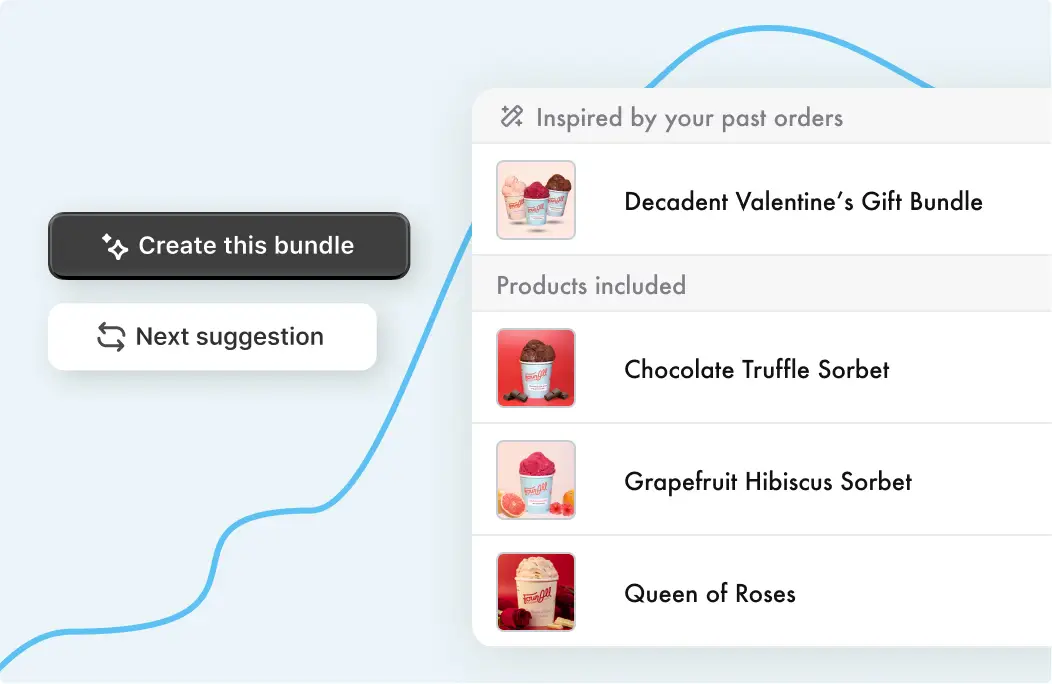
The bundle is created as an unlisted product in Shopify, giving you full control before publishing.
One important note: Bundle Magic needs order history to work. The more data you have, the smarter the ai-driven suggestions become, improving in near real-time as new orders come in.
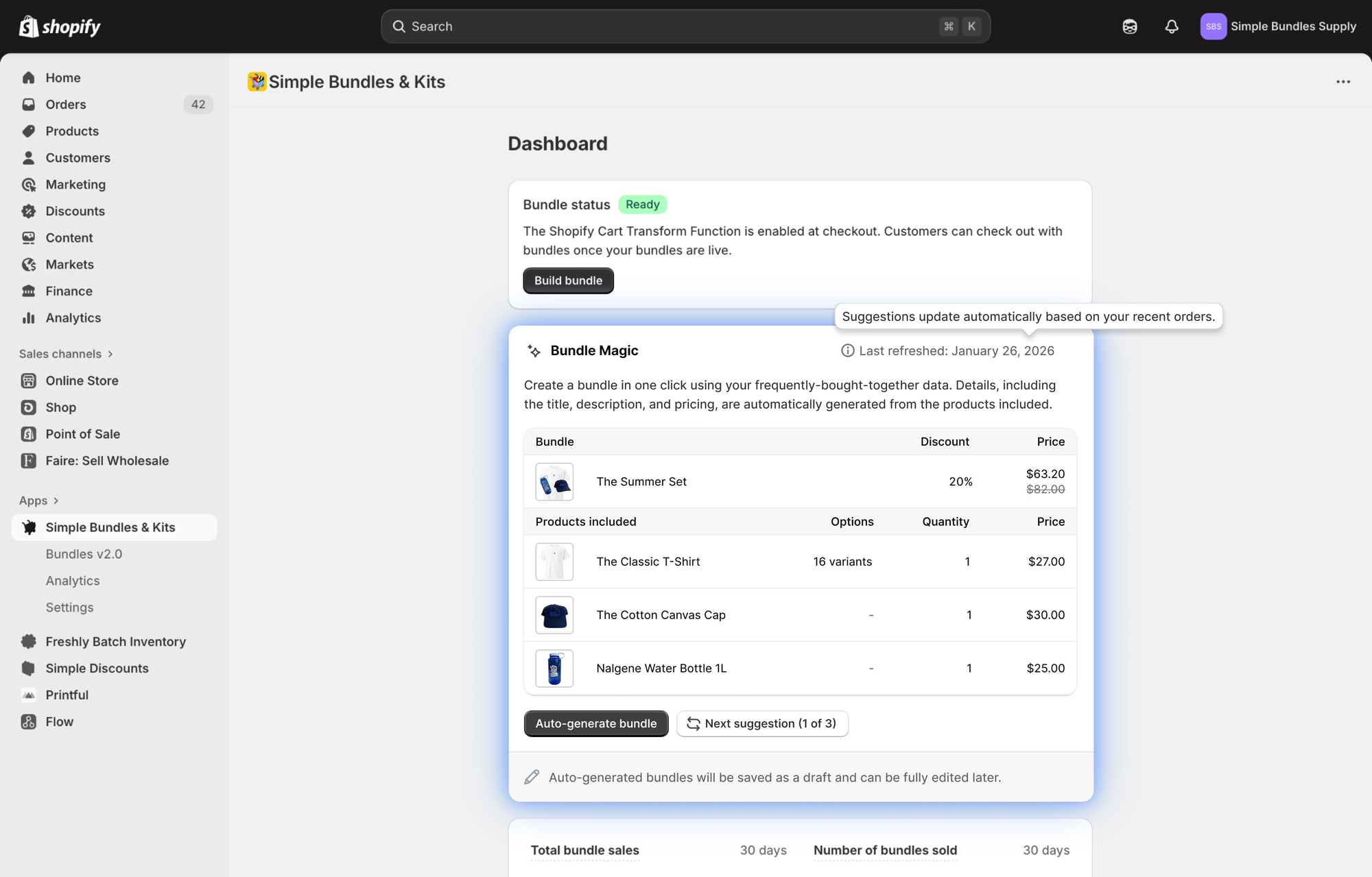
Getting started takes just a few steps.
First, make sure you have Simple Bundles installed and enough order history for the AI to analyze. There's no magic number, but generally six months of consistent orders gives Bundle Magic enough data to generate meaningful suggestions.
This helps ensure accurate metrics and stronger recommendations.
Next, navigate to Settings and find the Bundle Magic section. Here you can add custom instructions to guide how bundles are generated. Want to exclude add-on products? Avoid certain product types? Prefer bundles at a specific price point? This is where you tell the AI what matters to your merchandising strategy.
By default, Bundle Magic excludes add-on products like warranties and shipping protection. This keeps your bundle suggestions focused on core products rather than accessories that don't make sense as bundle components.
This is where you define your bundling strategies and align the tool with your broader merchandising and inventory management goals.
Once configured, Bundle Magic will surface suggestions based on your order patterns, helping you build personalized bundles tailored to your customers.
Just because Bundle Magic suggests a bundle doesn't mean you should publish it immediately. The AI gives you a strong starting point, but you know your brand better than any algorithm.
When reviewing a generated bundle, check a few things:
The title and description. AI-generated copy might be accurate but generic. Does it match your brand voice? Does it communicate the value of buying these products together? A quick edit can make the difference between "Product Bundle Set" and "The Complete Morning Routine Kit."
The pricing. Bundle Magic suggests prices based on individual product costs, but you might want to offer a discount to incentivize the bundle purchase. Consider what margin you need and what price point makes the bundle feel like a deal.
The imagery. Combined product images are convenient, but they might not match your store's aesthetic. If your brand has a specific photography style, you might want to create custom bundle imagery instead.
The products themselves. Even with good data, sometimes a suggestion doesn't quite fit. Maybe one of the products is being discontinued, or you know from customer feedback that certain items don't complement each other well. Trust your knowledge of your catalog.
Only activate the bundle when you're confident it represents your brand well and makes operational sense.
Bundle Magic works best when you treat it as a starting point, not a finished product. The AI handles the analysis you don't have time for, but the final decisions are yours.
Trust the AI when:
Override the AI when:
You can also guide future suggestions through the custom instructions in Settings. If Bundle Magic keeps suggesting bundles you don't want, add instructions to exclude certain product types or prioritize specific categories.
The goal is collaboration between your merchandising instincts and the AI's data analysis. Neither one alone is as powerful as both together.
A DTC skincare brand with 50 products might discover that their customers frequently buy cleanser, toner, and moisturizer together, but almost never add the face mask to that combination. Without Bundle Magic, they might have assumed the mask belonged in a "complete routine" bundle. With the data, they know to create a three-product bundle instead and market the mask separately.
A coffee company could learn that their decaf buyers consistently add a specific flavored roast. That's a bundle opportunity for the afternoon coffee crowd that they never would have identified manually.
A jewelry brand might find that customers who buy earrings frequently add a necklace from a completely different collection. Cross-collection bundles aren't intuitive, but the data says they work.
In each case, the merchant saves hours of analysis and gets suggestions grounded in actual customer behavior rather than assumptions.
If you've been putting off bundle creation because you don't know where to start, your order history already has the answer.
Open Bundle Magic in Simple Bundles and look at the suggestions based on your data. Pick one that aligns with your current goals. Review the generated product, make any adjustments to the title, pricing, and imagery, and set it live.
Start with a single bundle. Watch how it performs. Use what you learn to refine your approach for the next one.
Your customers have been telling you what to bundle this whole time. Now you have a way to listen.
Learn how to sell Shopify bundles on TikTok Shop with Simple Bundles. Complete 2026 guide.
If you're selling bundles across multiple channels, you're dealing with a gap in how Shopify handles off-platform orders.
Here's the thing about multi-location inventory in Shopify: the platform tracks stock at each location independently.

