
Simple Bundles vs. Fast Bundle. Which is best for Shopify bundles?
Both Simple Bundles and Fast Bundle help Shopify merchants create high-converting product bundles, but they take different approaches to how bundles look and how they scale behind the scenes.
Looking for a Fast Bundle alternative? Or trying to understand the tradeoffs?

Simple Bundles
Simple Bundles is built for brands wanting customizable bundles like mix and match, BOGO, and free gifts, with accurate inventory, reliable fulfillment, and Shopify native features.

Fast Bundle
Fast Bundle is a strong option for merchants who want ready-made visual bundle templates for quick promotions like multipacks, BOGO, and mix & match offers.
Simple Bundles vs. Fast Bundle: feature comparison
| Feature | Simple Bundles | Fast Bundle |
|---|---|---|
| Bundle types supported | Fixed bundles, mix & match, volume discounts, BOGO, upsells, free gift with purchase, subscription bundles, add-ons | Fixed bundles, kits, multipacks, mix & match |
| Visual approach | Brand-controlled, theme-native layouts | Pre-built visual templates |
| Frontend customization | ✅ Fully customizable (theme & dev friendly) | ❌ Template-based |
| Inventory sync | ✅ Automatic SKU-level sync | ⚠️ Partial |
| Bundle treated as real Shopify product | ✅ Yes | ❌ No |
| Shopify compatibility | ✅ Native checkout and Shopify POS | ⚠️ Frontend-focused |
| Cart Transform support | ✅ Yes | ❌ No |
| POS / ERP ready | ✅ Yes | ❌ No |
Two bundle architectures, and why the difference matters later
Most Shopify bundle apps fall into one of two architectural categories.
1. Frontend-first (promotion-oriented) bundles
Fast Bundle largely follows this model.
Strengths:
- Quick setup
- Pre-built visual layouts
- Ideal for short-term promotions
Tradeoffs:
- Bundles aren't Shopify products
- Inventory, fulfillment, and reporting rely on abstractions
- Edge cases emerge as complexity increases
2. Product-native (system-oriented) bundles
This approach creates Shopify products that are tied directly to component SKUs.
Simple Bundles follows this model.
Strengths:
- Accurate inventory tracking
- Clean fulfillment and reporting
- Consistent behavior across checkout, POS, and integrations
Tradeoffs:
- Less "out-of-the-box" UI decoration
- Frontend presentation is handled through themes, not templates
Why visual bundle apps work so well at the start
Visual-first bundling tools exist for a reason. For many Shopify merchants, the goal is to:
- Improve product discovery
- Encourage larger purchases
- Highlight complementary items
- Launch promotions quickly
For early-stage or promotion-heavy use cases, these bundling apps look sufficient, but eventually every scaling brand runs into the same issues.
Where visual-only bundle builders start to show cracks
Problems rarely appear when you launch your first bundle. They tend to show up when bundles:
- Start selling consistently
- Become permanent products, not promotions
- Touch fulfillment, inventory, POS, or subscriptions
At that point, merchants encounter issues like:
- Inventory drift when bundle components are shared across products
- Overselling or stockouts during high order volume
- Ambiguous order line items that confuse fulfillment teams or 3PLs
- Discount conflicts with Shopify automatic discounts or other apps
- Theme or compatibility issues after Shopify or theme updates
- Reporting gaps where bundle revenue and margins don't reconcile cleanly
How Simple Bundles approaches frontend presentation
Simple Bundles does not ship a large library of pre-designed bundle widgets or visual templates. It does, however, give merchants full control over how bundles look without sacrificing Shopify-native behavior.
What this means:
- Create bundles as real Shopify products
- Render them using existing theme sections and layouts
- Customize presentation using standard Shopify tooling
- Extend layouts with developer support when needed
At the same time, bundles are treated as real Shopify products, which means:
- Inventory stays in sync automatically
- Fulfillment and reporting remain clean
- Bundles work consistently across checkout, POS, and integrations
How DIBS Beauty built on-brand bundles without sacrificing operations
DIBS Beauty uses bundles as a core merchandising strategy. They needed bundle pages that felt fully on-brand and a system that could handle inventory, fulfillment, and growth without friction.
With Simple Bundles, DIBS was able to:
- Create visually consistent bundle experiences
- Design custom bundle pages that matched their storefront
- Maintain real-time inventory accuracy
- Scale bundles without introducing fulfillment issues
How to choose the right bundling approach for your store
If you're deciding between visual-first and scalable bundle solutions, ask yourself:
- Are bundles promotional experiments or permanent products?
- Do I want preset layouts or theme-native control?
- Will bundles need to work across POS, subscriptions, or 3PLs?
- What happens to inventory and fulfillment if bundle sales double?
If speed and simplicity are the priority, visual-first tools can be a great starting point.
If bundles are becoming part of your core catalog, investing in a Shopify-native foundation can save significant time and risk later.
Why merchants switch from Fast Bundle to Simple Bundles
Merchants typically switch when bundle issues escalate from annoying to business-critical.
Common triggers include:
- Inventory errors leading to overselling or stockouts
- 3PL confusion due to opaque order line items
- Increased support tickets tied to bundle orders
- Finance teams questioning bundle margin accuracy
- Launching subscriptions, wholesale, or international fulfillment
- Preparing for higher order volume or operational audits
Simple Bundles gives you long-term flexibility—both visually and operationally.
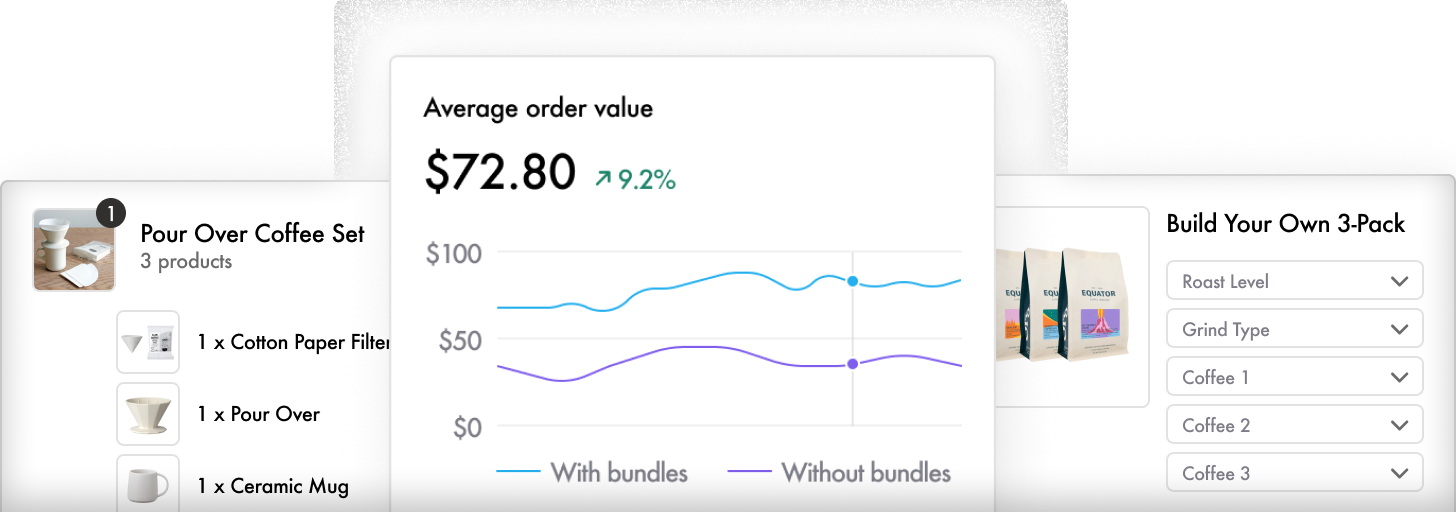
Our brands typically see 20% more in average order value, 17% higher conversion rates, and 80% fewer bundle fulfillment issues that cost time and money.
Frequently asked questions about Simple Bundles or Fast Bundle
Is Simple Bundles a Shopify app?

Yes. Simple Bundles is a Shopify app available on the Shopify App Store. It integrates natively with your store and uses Shopify's core product architecture for bundles.
Can Simple Bundles work with other apps?
Yes. Because Simple Bundles creates real Shopify products for bundles, it works reliably with other apps that rely on product data—including POS, subscriptions, 3PLs, and inventory management tools.
Does Fast Bundle work with other apps?
Fast Bundle's frontend-focused, virtual-bundle approach can lead to compatibility issues with other Shopify apps and functionalities that depend on real product data—such as inventory sync, POS, and fulfillment integrations.
Can I migrate from Fast Bundle to Simple Bundles?
Yes. Most merchants define bundle products and link existing SKUs. Simple Bundles has a dedicated support team that regularly helps merchants migrate from existing bundling setups. This is especially helpful for stores with large catalogs, multiple bundle types, or operational edge cases that require planning.
How do Simple Bundles and Fast Bundle handle inventory?
Simple Bundles creates real bundle products tied to component SKUs, so inventory updates automatically as bundles sell—preventing stock drift. Fast Bundle uses a virtual-bundle model, which can result in partial or abstracted inventory sync and more risk of overselling or stockouts as complexity grows.
What kind of support do they offer?
Simple Bundles provides dedicated support and documentation to help with setup, migration, and scaling. Support quality and availability vary by plan; see each app's listing for details.
Can I try Simple Bundles for free?
Yes. You can try Simple Bundles for free on the Shopify App Store. Check out our free plan to get started.
The easiest way to grow AOV
Join 25,000+ Shopify merchants already using Simple Bundles to drive their growth.
Try Simple Bundles free