
Simple Bundles vs. Rebuy Bundles: Which Is Best for Shopify Bundles?
Behind the scenes, Simple Bundles and Rebuy take fundamentally different approaches to how bundles are structured, how inventory behaves, and how deeply bundling is tied into your broader tech stack.
Looking for a Rebuy alternative for Shopify bundles?

Simple Bundles
Simple Bundles is positioned around a product-native, Shopify-first architecture where bundles are treated as real Shopify products tied to component SKUs, built for accurate inventory, clean fulfillment, and scaling across channels like POS and subscriptions.

Rebuy Bundles
Rebuy Bundles are part of a broader personalization and Smart Cart engine, typically created through dynamic frontend logic, cart-level grouping, and rule-based automation designed to optimize revenue rather than create product-native bundle infrastructure.
Two bundle architectures and why the difference matters later
Most Shopify bundle solutions fall into one of two architectural categories.
1. Frontend-first (personalization-oriented) bundles
Rebuy largely follows this model.
Rebuy is best known as a personalization and revenue optimization platform. Bundling exists inside its ecosystem alongside:
- AI-powered recommendations
- Smart Cart
- Post-purchase offers
- Subscription upsells
- Dynamic cross-sells
Bundles are typically created through:
- Cart-level logic
- Frequently-bought-together widgets
- Rule-based automation
- Line-item additions with dynamic pricing adjustments
In many implementations, the bundle is not a single "product-native" object in Shopify. Instead, individual SKUs are added to cart together, often with conditional pricing or automated discounting logic applied.
2. Product-native (system-oriented) bundles
This approach creates real Shopify products tied directly to component SKUs.
Simple Bundles follows this model.
Bundles exist as first-class products inside Shopify's catalog. Each bundle is tied to component SKUs, and inventory sync happens at the component level.
Strengths
- Accurate inventory tracking at the SKU level
- Clean fulfillment breakdown for warehouses and 3PLs
- Works across Shopify checkout, POS, subscriptions, draft orders
- Designed for ERP, WMS, and high-order-volume environments
- Bundle performance reporting aligns with product analytics
Tradeoffs
- Less emphasis on AI-driven merchandising
- No Smart Cart-style guided upsell widgets out of the box
- Frontend presentation relies on theme design rather than a proprietary builder UI
The architecture is less "marketing-engine-first" and more infrastructure-focused.
Simple Bundles vs. Rebuy: feature comparison
| Feature | Simple Bundles | Rebuy Bundles |
|---|---|---|
| Primary focus | Product-native bundle infrastructure | Personalization, Smart Cart, revenue optimization |
| Bundle types supported | Fixed bundles, mix & match, multipacks, subscription bundles, add-ons, BOGO, free gifts | Frequently bought together, dynamic bundles, cart-level kits, subscription upsells |
| Visual approach | Brand-controlled, theme-native layouts | Widget-based Smart Cart and product page modules |
| Frontend customization | ✅ Fully customizable via theme | ⚠️ Customizable within Rebuy widgets & placements |
| Inventory sync | ✅ Automatic SKU-level sync tied to component products | ⚠️ Component SKUs tracked individually; bundle identity is dynamic |
| Bundle treated as real Shopify product | ✅ Yes (product-native architecture) | ⚠️ Often cart-assembled from component SKUs |
| Shopify POS compatibility | ✅ Yes | ⚠️ Depends on configuration; primarily optimized for Online Store |
| Subscription support | ✅ Yes (works with subscription apps) | ✅ Strong integration with subscription upsells |
| Draft order compatibility | ✅ Supported | ⚠️ Depends on configuration; cart-based logic may not translate cleanly |
| Sales channel support | ✅ Works across Shopify channels | ⚠️ Primarily Online Store + Checkout-focused |
| ERP / 3PL readiness | ✅ Designed for operational ecosystems | ⚠️ Requires operational planning if bundles are core SKUs |
| Pricing entry point | Free plan available | Tiered pricing based on store revenue |
Where Rebuy limitations appear over time
These are not "software flaws." They're architectural tradeoffs that come with a personalization-first approach.
1) When bundles become permanent catalog products
Rebuy excels at dynamic upsells.
But if bundles become:
- Core SKUs in your catalog
- SEO-driven PDPs
- Seasonal kits merchandised as standalone products
The lack of a product-native identity can create reporting fragmentation.
Marketing teams may love the flexibility. Ops teams may need clearer SKU mapping.
2) Inventory complexity with shared SKUs
When multiple dynamic bundles include overlapping SKUs:
- Forecasting can become harder
- Bundle-level inventory planning requires custom tracking
- Finance reporting may need manual reconciliation
Since bundles are often cart-assembled, the system optimizes for conversion rather than inventory modeling.
3) Fulfillment clarity for 3PLs and ERP systems
Because Rebuy bundles are often dynamic groupings:
- Warehouses fulfill component SKUs
- Bundle identity may not exist as a discrete catalog entity
- ERP systems may not classify the bundle as a sellable SKU
For high-volume brands, that distinction can matter operationally.
4) Scaling beyond marketing optimization
Rebuy is built to optimize revenue.
But as brands mature into:
- Multi-location inventory
- Retail POS
- Subscription-first models
- Complex ERP environments
Merchants sometimes look for bundling systems that prioritize structural reliability over marketing flexibility.
How Simple Bundles approaches bundling differently
Simple Bundles' positioning is consistent: product-native, Shopify-first architecture focused on operational reliability.
Shopify-native bundles with real products + component SKUs
Bundles are real products.
Inventory sync happens automatically at the component level.
Orders break down cleanly for fulfillment and reporting.
When bundles move from "upsell tactic" to "core product strategy," this structural clarity matters.
Theme-based presentation with full control
Instead of proprietary Smart Cart widgets, Simple Bundles leans into theme-native control.
That matters if you want to:
- Design bundles as permanent PDPs
- Match brand UI precisely
- Avoid dependency on one personalization engine
- Maintain long-term frontend flexibility
You're not locked into a specific merchandising widget structure.
Scaling across POS, subscriptions, 3PLs, and high order volume
Simple Bundles supports:
- Shopify POS
- Subscription apps
- Draft orders
- ERP and WMS workflows
- Multi-location inventory
The goal is predictability across the entire ecosystem.
DIBS Beauty on why bundle architecture matters
DIBS Beauty is a strong example because bundles are a meaningful part of their merchandising strategy.
Their mix-and-match experiences must:
- Feel seamless to shoppers
- Maintain SKU-level inventory accuracy
- Stay clean operationally as SKU count and order volume grow
The key takeaway isn't simply that bundles increase AOV.
It's that when bundles become a primary shopping pathway, backend architecture determines whether operations stay predictable as scale increases.
How to choose between Simple Bundles and Rebuy
Here's a practical decision framework tied to real tradeoffs.
Choose Rebuy if you prioritize…
- AI-powered upsells
- Smart Cart optimization
- Personalized "frequently bought together" logic
- Behavior-triggered revenue automation
- Subscription upsell flows
Choose Simple Bundles if you prioritize…
- Permanent bundled products that behave like real SKUs
- Accurate inventory + clean fulfillment
- Confidence scaling into POS, subscriptions, multi-location
- ERP/WMS readiness
- Long-term operational clarity
Why merchants switch from Rebuy Bundles to Simple Bundles
Most switches aren't dissatisfaction with Rebuy's personalization power.
Common triggers include:
- Bundles becoming core catalog products — When bundles shift from dynamic upsell to core PDP strategy, merchants want product-native structure.
- POS or omnichannel expansion — If retail, pop-ups, or in-store sales become important, having bundles behave like standard Shopify products simplifies operations.
- Operational maturity (ERP, 3PL, multi-location) — As fulfillment complexity increases, product-native bundle mapping reduces reconciliation work.
- Inventory accuracy concerns — When bundles share overlapping SKUs across many campaigns, merchants often prefer explicit SKU-level sync tied to a real product structure.
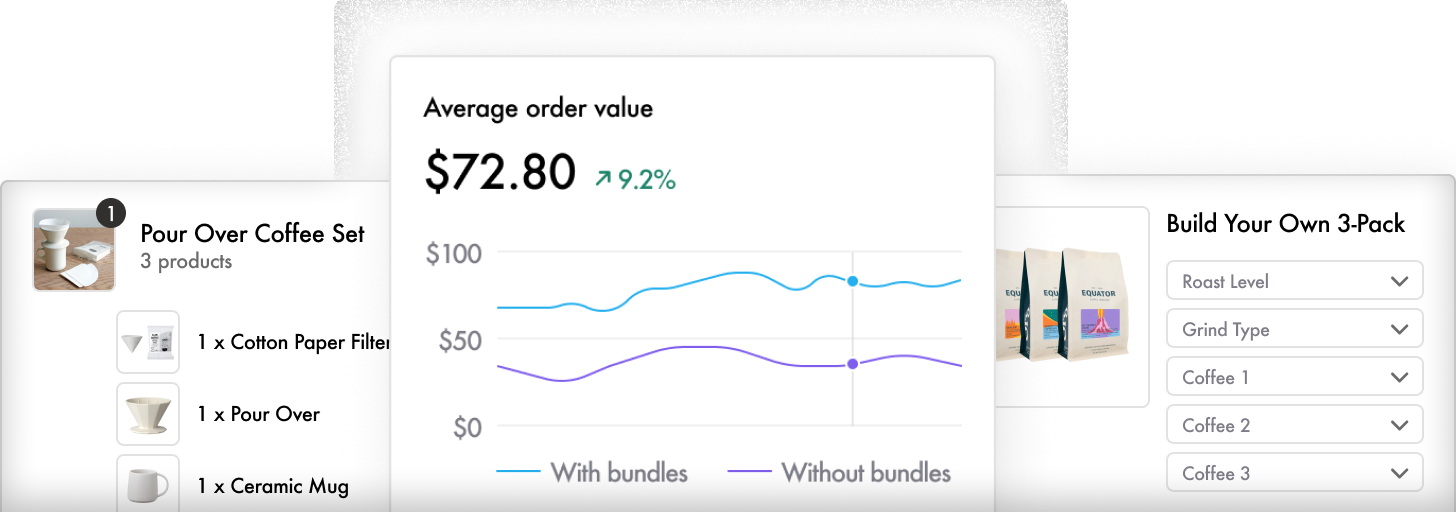
Our brands typically see 20% more in average order value, 17% higher conversion rates, and 80% fewer bundle fulfillment issues that cost time and money.
Frequently asked questions about Simple Bundles or Rebuy
Is Rebuy a full Simple Bundles alternative?

Not exactly. Rebuy is primarily a personalization and Smart Cart engine. Simple Bundles focuses specifically on product-native bundle infrastructure.
Why does product-native bundle architecture matter?
When bundles are treated as real Shopify products: inventory sync is tied directly to component SKUs; orders break down cleanly for fulfillment; reporting aligns with product performance; POS and draft orders work without special configuration. With dynamic cart-based bundles, the system optimizes for conversion. With product-native bundles, the system optimizes for operational clarity. As order volume increases, that distinction becomes more important.
Which solution is better for long-term scaling?
For short-term AOV optimization, Rebuy is powerful. For long-term operational scalability — especially if you plan to: use Shopify POS, add subscription products, work with a 3PL or ERP, manage multi-location inventory — Simple Bundles is typically the more durable architecture.
Will Simple Bundles limit my frontend design flexibility?
No — it actually gives you more control. Instead of locking you into a widget-based bundle builder, Simple Bundles uses theme-native presentation. That means your team (or developer) can design bundles exactly like any other PDP in your store. You're not constrained by a predefined builder layout.
Is Simple Bundles compatible with POS?
Yes. Simple Bundles lists Shopify POS compatibility and is designed to work across Shopify sales channels.
Can I use Simple Bundles and Rebuy together?
Yes — and many scaling brands do. Rebuy can power personalization and Smart Cart optimization. Simple Bundles can power permanent product bundles with reliable backend behavior. They solve different problems. But if you're choosing only one specifically for bundle infrastructure, Simple Bundles is purpose-built for that role.
Which is better for permanent bundle products?
Simple Bundles is typically better suited when bundles need to function as stable catalog products across fulfillment, reporting, and sales channels.
Try Simple Bundles
If you're evaluating a Rebuy alternative and want product-native bundles with accurate inventory and operational reliability, Simple Bundles is built for that path. Start with our free plan and grow without reworking your bundle architecture later.
Try Simple Bundles free