
Simple Bundles vs. Shopify Bundles: Which Is Best for Shopify Bundles?
Compare Simple Bundles and Shopify Bundles on architecture, inventory accuracy, customization, and scalability to choose the right Shopify bundle app for long-term growth.
Two different approaches to Shopify bundles

Simple Bundles
Simple Bundles is built for brands wanting customizable bundles like mix and match, BOGO, and free gifts, with accurate inventory, reliable fulfillment, and Shopify native features.

Shopify Bundles
Shopify Bundles is a strong option for merchants who want a simple, free, fixed-bundle solution built directly into Shopify for straightforward multipacks and starter kits.
If you're evaluating a Shopify Bundles alternative or trying to understand the difference between Shopify's native bundling app and a dedicated solution like Simple Bundles, you're not alone.
Both tools allow merchants to sell bundles on Shopify. But they are built on fundamentally different architectural philosophies, and that difference becomes more important as your store grows.
Simple Bundles vs. Shopify Bundles: feature comparison
| Feature | Simple Bundles | Shopify Bundles |
|---|---|---|
| Bundle types supported | Fixed bundles, mix & match, build-your-own, BOGO, volume bundles, free gifts, subscription bundles | Fixed bundles and multipacks |
| Visual approach | Theme-native (fully customizable) | Standard Shopify product layout |
| Frontend customization | ✅ Full control via theme & dev | ⚠️ Limited to Shopify product template |
| Inventory sync accuracy | ✅ SKU-level automatic sync | ✅ Native SKU sync |
| Bundle treated as real Shopify product | ✅ Yes | ✅ Yes |
| Checkout compatibility | ✅ Native Shopify checkout | ✅ Native Shopify checkout |
| Shopify POS compatibility | ✅ Yes | ⚠️ Works for fixed bundles; limited advanced logic |
| Subscription compatibility | ✅ Designed to work with subscription apps | ❌ No advanced subscription logic |
| Cart Transform support | ✅ Yes | ❌ No |
| ERP / 3PL readiness | ✅ Built for operational clarity | ⚠️ Basic bundle visibility |
Two bundle architectures and why the difference matters
Even though both tools are Shopify-native, they differ in execution depth and flexibility.
How Shopify Bundles creates bundles
Shopify Bundles creates fixed bundles directly within Shopify's product framework.
Key characteristics:
- Bundles are created in the Shopify admin
- Component SKUs are linked
- Inventory syncs automatically
- Orders reflect bundle relationships natively
This is clean and lightweight, but limited to fixed structures. There is no built-in support for: complex conditional logic, mix-and-match builders, tiered discounts, subscription-aware bundling logic, or advanced merchandising workflows.
How Simple Bundles approaches bundling
Simple Bundles also creates real Shopify products tied directly to component SKUs. However, its architecture is designed to:
- Support more bundle types
- Maintain SKU-level inventory accuracy
- Preserve clean fulfillment mapping
- Scale across POS, subscriptions, and Cart Transform
- Work reliably with 3PLs and ERPs
The difference shows in how much operational complexity the system is designed to handle.
Where Shopify Bundles limitations appear over time
Problems rarely appear when you launch your first bundle. They tend to show up when bundles:
- Start selling consistently
- Become permanent catalog products
- Expand beyond simple fixed kits
- Touch subscriptions, POS, or complex fulfillment workflows
At that point, merchants can run into constraints like:
- Inability to support mix-and-match or build-your-own configurations
- Needing separate apps to handle BOGO or gift-with-purchase logic
- Workarounds when launching subscription bundles
- Limited flexibility if merchandising strategies evolve
- Rigid bundle structures that are difficult to extend without reconfiguration
- Reporting that remains fixed-bundle focused without advanced component-level visibility
None of this means Shopify Bundles is flawed. It means it was intentionally designed to solve a specific problem: simple, fixed bundles inside Shopify's core product system. And for many merchants, that's enough.
But for brands treating bundles as a core merchandising engine — across promotions, subscriptions, POS, and high-volume operations — flexibility and long-term extensibility start to matter more.
How Simple Bundles approaches bundling differently
Simple Bundles is built for brands that treat bundles as permanent catalog products, not temporary promotions.
Product-native foundation
- Bundles are real Shopify products
- Component SKUs stay connected
- Inventory syncs automatically
- Orders map cleanly for fulfillment
Theme-based presentation
Instead of locking merchants into preset widgets: Bundles render using existing Shopify theme sections. Developers can extend layouts. Brands maintain visual consistency. This gives full design control without sacrificing operational reliability.
Built for scale
Simple Bundles is designed to support: POS, Subscriptions, Cart Transform, High order volume, 3PL fulfillment workflows, ERP integrations. As complexity increases, the architecture remains stable.
How DIBS Beauty scales with Simple Bundles
DIBS Beauty uses bundles as a core merchandising strategy. They needed: Fully branded bundle pages, accurate SKU-level inventory, clean fulfillment mapping, and scalability across growth stages.
Because Simple Bundles creates real Shopify products tied to component SKUs, DIBS was able to: maintain inventory accuracy during high demand, avoid fulfillment confusion, keep reporting clean, and scale without re-platforming their bundling logic.
How to choose between Simple Bundles and Shopify Bundles
Here's a practical decision framework that reflects real merchant tradeoffs:
Choose Shopify Bundles if you prioritize…
- Simple, fixed starter kits or multipacks
- A free, lightweight solution built directly by Shopify
- Minimal configuration and quick setup
- Basic bundling needs without advanced promotional logic
Choose Simple Bundles if you prioritize…
- Permanent bundled products that behave like real Shopify products
- Mix-and-match, BOGO, build-your-own, or subscription bundles
- Accurate inventory and clean fulfillment tied directly to component SKUs
- Confidence that bundles will scale across POS, subscriptions, multi-location inventory, and 3PL/WMS systems
- Full control over how bundles look using your theme, not preset constraints
Why merchants switch from Shopify Bundles to Simple Bundles
Most switches aren't caused by dissatisfaction with Shopify Bundles itself. It does what it's designed to do: simple, fixed bundles inside Shopify.
Common triggers tend to look like this:
- Bundles evolve beyond fixed kits — When merchandising strategies expand into mix-and-match builders, build-your-own sets, or BOGO/gift-with-purchase logic, merchants typically need additional tooling. Many choose to consolidate into a more flexible bundling architecture.
- Subscription launches — As brands introduce subscriptions, bundles often need to be sold as subscription products or combine subscription and one-time items. Shopify Bundles does not provide advanced subscription-aware bundle logic. Simple Bundles is designed to support subscription integrations more directly.
- POS and omnichannel expansion — Fixed bundles can sell through POS; when brands expand into retail, pop-ups, wholesale, or multi-location inventory, they often want bundles to behave predictably across every sales channel.
- Operational maturity (3PLs, ERP, finance reporting) — As bundles move from starter kits to core revenue drivers, teams ask how components map in fulfillment, how margin reporting reconciles, and what happens when shared components sell across multiple bundle types. Merchants often prefer architectures designed for long-term operational scalability.
Final verdict: which is best?
Simple Bundles is built for scale. You can start with our free plan and build bundles that grow with your business, without reworking your architecture later.
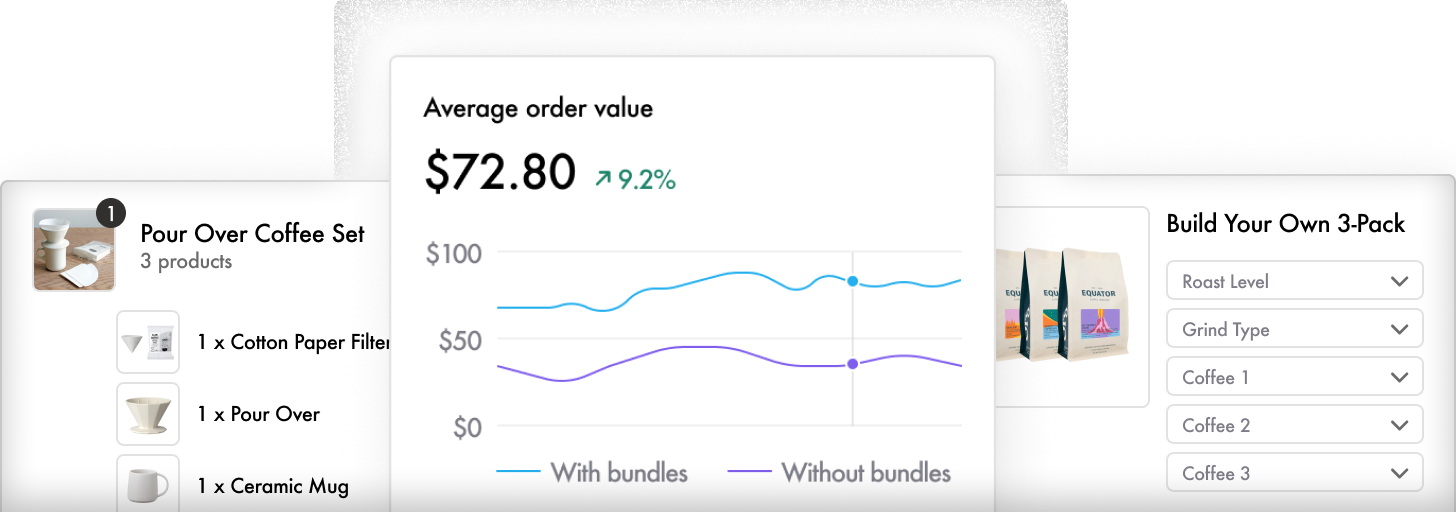
Our brands typically see 20% more in average order value, 17% higher conversion rates, and 80% fewer bundle fulfillment issues that cost time and money.
Frequently asked questions about Simple Bundles or Shopify Bundles
Is Shopify Bundles enough for most stores?

For simple fixed bundles, yes. For complex bundle strategies, it may feel limited.
Can Simple Bundles replace Shopify Bundles?
Yes. Merchants can recreate bundle products within Simple Bundles while maintaining SKU-level accuracy.
Can Shopify Bundles handle mix-and-match or build-your-own bundles?
No. Shopify Bundles supports fixed bundles and multipacks. If you need customer-selectable bundle builders, you'll need a more flexible app like Simple Bundles.
Will Shopify Bundles affect inventory accuracy?
Shopify Bundles syncs component inventory natively. However, complexity increases when merchants want multiple bundle types, conditional logic, or subscription variations, which is where more advanced bundling systems are often considered.
Which app works better with subscriptions?
Simple Bundles is designed to integrate cleanly with subscription workflows and recurring logic.
Does Shopify Bundles work with POS?
Fixed bundles can sell through POS. More advanced bundle logic is not supported.
Is Simple Bundles free?
Yes. Shopify Bundles is free. Simple Bundles offers a free plan and paid tiers for advanced functionality.
The easiest way to grow AOV
Join 25,000+ Shopify merchants already using Simple Bundles to drive their growth.
Try Simple Bundles free