Tina Donati is the Head of Marketing at Simple Bundles and has spent the past 7+ years helping Shopify brands streamline their tech stack and unlock growth through smarter product bundling, better UX, and cleaner ops.
ecommerce operations
How to build a better bundle inventory management system
This guide explains why bundle inventory management often breaks down as brands scale, and how to keep bundles accurate, available, fulfillable, and profitable.
Tina Donati is the Head of Marketing at Simple Bundles and has spent the past 7+ years helping Shopify brands streamline their tech stack and unlock growth through smarter product bundling, better UX, and cleaner ops.
Every ecommerce brand hits a point where growth stops being about new campaigns or flashier content and becomes about something far less glamorous: operations.
And nothing exposes weak operational foundations faster than bundled products.
Which is ironic, because bundles are supposed to be the hero tactic. They lift average order value, drive profitable merchandising, improve retention, and make customers feel like they’re getting more value. Most brands don’t fail because the bundle concept is bad — they fail because the inventory management architecture behind the bundle was never built to support it.
This guide is not about creating bundles. It’s about making them work. The messy, operationally complicated, nobody-told-you-this-part work.
The kind that determines whether your ecommerce business can scale bundles without constant stockouts, operational chaos, or overspending on shipping.
What Is Bundle Inventory Management?
Bundle inventory management is the process of ensuring that the items that make up a product bundle (its components) are tracked accurately across:
Shipping rates reflect the true dimensions and weight
You avoid split shipments
Returns and refunds stay accurate
Inventory tracking stays reliable across every system
Poorly managed bundles create friction that grows exponentially as order volume increases — especially when your Shopify store is generating orders across multiple sales channels and pushing data through different systems.
Why Bundle Inventory Management Fails (And Why It’s So Hard)
When we speak to brands about bundling, the problems they describe almost always sound like this:
“We oversold again — we didn’t even know that SKU was part of another bundle.”
“Our 3PL keeps packing the wrong items.”
“Shipping costs are chaotic.”
“Bundles constantly go out of stock even though everything looks fine on Shopify.”
“Returns are a nightmare.”
None of these are bundling issues. They are shopify sku architecture issues disguised as bundle problems, usually caused by the system treating each individual item differently across platforms.
The real root causes usually fall into three buckets:
1. Shopify thinks in SKUs; warehouses think in items; bundles exist in between.
Shopify does not calculate bundle inventory automatically. Instead, Shopify:
Tracks individual products at the variant level
Doesn’t maintain native bundle logic unless you use Shopify Bundles or a bundles app like Simple Bundles
Uses location-level data to determine bundle availability
2. Most 3PL systems are SKU-first, not logic-first
3PLs think in terms of:
What got scanned
What is in bin X
What is physically pickable
If you don’t feed 3PLs the correct bundle components, they will:
Pack the wrong individual components
Ship incomplete bundles
Substitute complementary products without telling you
Create internal kitting processes that destroy your inventory sync accuracy
3. Multi-location fulfillment complicates every bundle
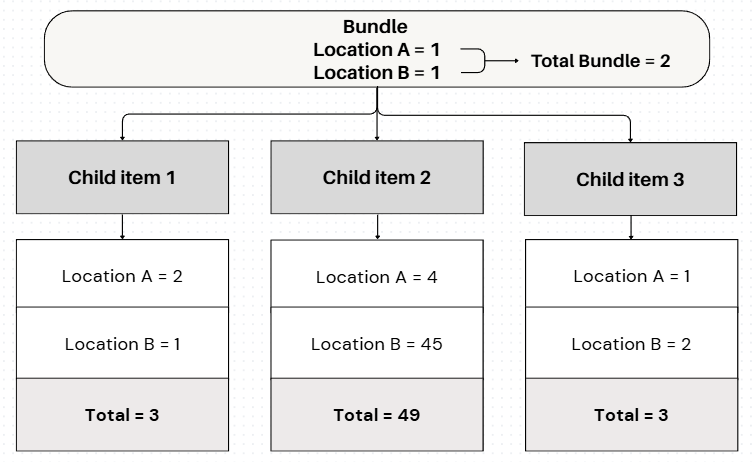
A bundle is only in stock if all components are in stock in the same pickable location.
But many brands unknowingly:
Stock 80% of the components in Location A
Stock the remaining 20% only in Location B
Shopify sees this as: “Both components exist somewhere, so sure—the bundle is in stock.”
Your 3PL sees: “We can’t pick this from any single warehouse.”
The result? Split shipments, wrong shipping rates, or fulfillment failure.
A BOM is the operational source of truth
It’s how everyone — Shopify, your 3PL, your team — knows exactly what the bundle is.
A real BOM includes:
Parent SKU
Component SKUs
Quantities
Packaging rules
Whether items show in cart
Whether they show in packing slips
Substitution rules
Inventory deduction rules
Pre-kitting instructions
Dimensional info
Without a BOM, every system involved in fulfillment is forced to make assumptions. Assumptions are the primary cause of:
Missing items in shipped bundles
Incorrect stock counts
Fulfillment slowdowns during high volume periods
Manual correction work by warehouse teams
Inconsistent customer experiences
Excess inventory or accidental stockouts
A well-maintained BOM is the backbone of any strong inventory management system and is essential for brands that want to optimize bundle operations.
Inventory Logic: The Determining Factor Behind Bundle Reliability
Every bundle relies on one of three inventory models. Understanding the differences between them—and their implications—is essential for choosing the right operational strategy.
1. Location-Based Bundle Inventory
This model requires that all bundle components be available at the same fulfillment location. If even one component is missing, the bundle is considered unavailable.
Operational impact:
Prevents split shipments
Ensures accurate fulfillment
Avoids carrier overcharges caused by multi-origin orders
Reduces packaging complexity
However, it can also lead to unexpected “out of stock” scenarios if components are unevenly distributed across locations. Brands with multiple fulfillment nodes often encounter this when the merchandising team assumes global availability but the warehouse operates within regional inventory constraints.
2. Pooled Inventory
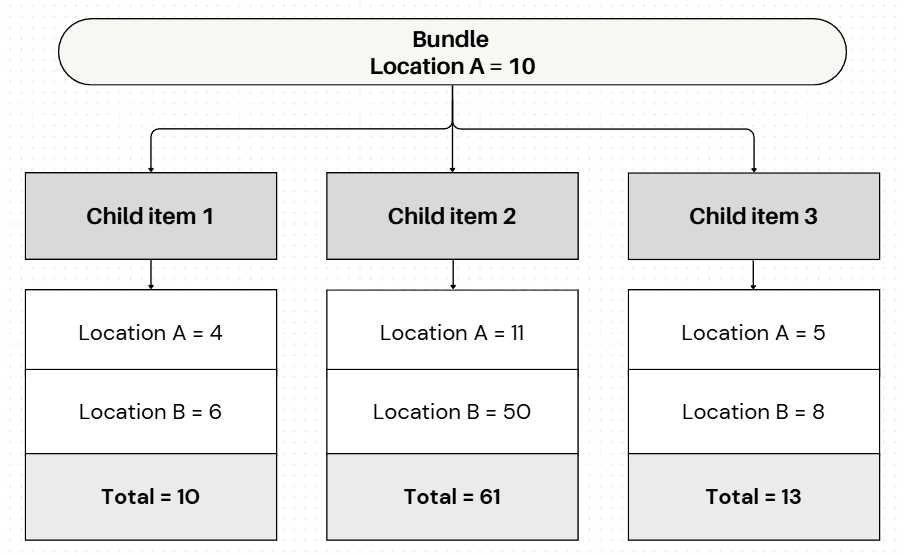
Pooled inventory expands bundle availability by using the combined total inventory of all components across all locations.
This model increases storefront sell-through but introduces risk:
Routing decisions may pull items from multiple warehouses
Shipping costs increase due to cross-zone shipments
Delivery times become inconsistent
Inventory buffers become harder to maintain
Complexity in forecasting purchase orders and reorder planning
Pooled inventory works best when shipping cost variance is low or when multi-node routing is tightly controlled.
3. Dynamic Inventory Validation
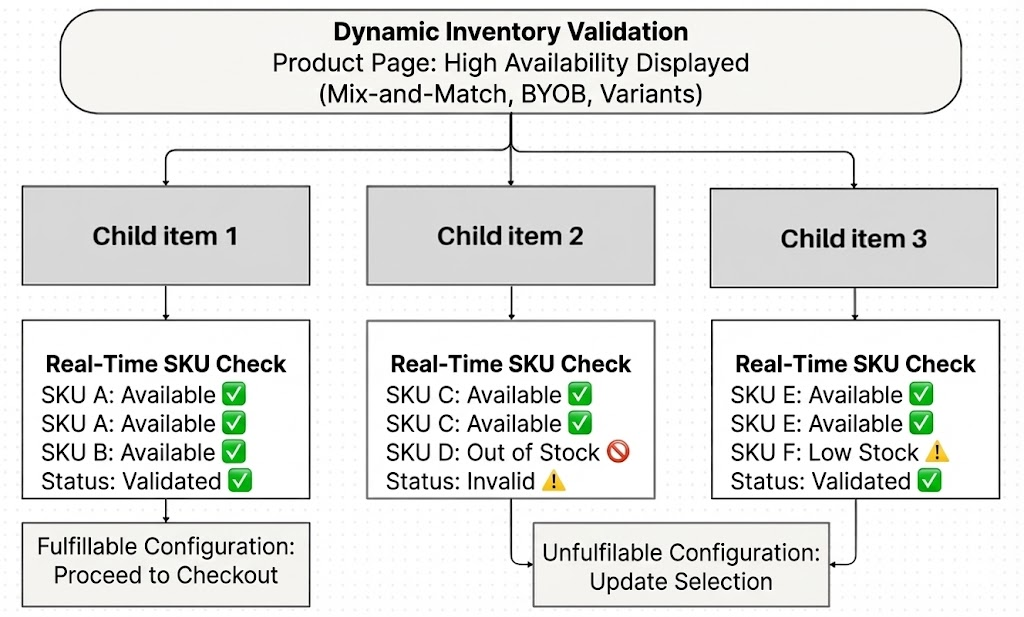
This model displays high bundle availability on the product page but validates SKU-level availability when the shopper builds a bundle or proceeds to checkout.
Dynamic validation is essential for:
Mix-and-match bundles
Build-your-own boxes
Bundles with variant-level dependencies
Configurable sets with multiple possible combinations
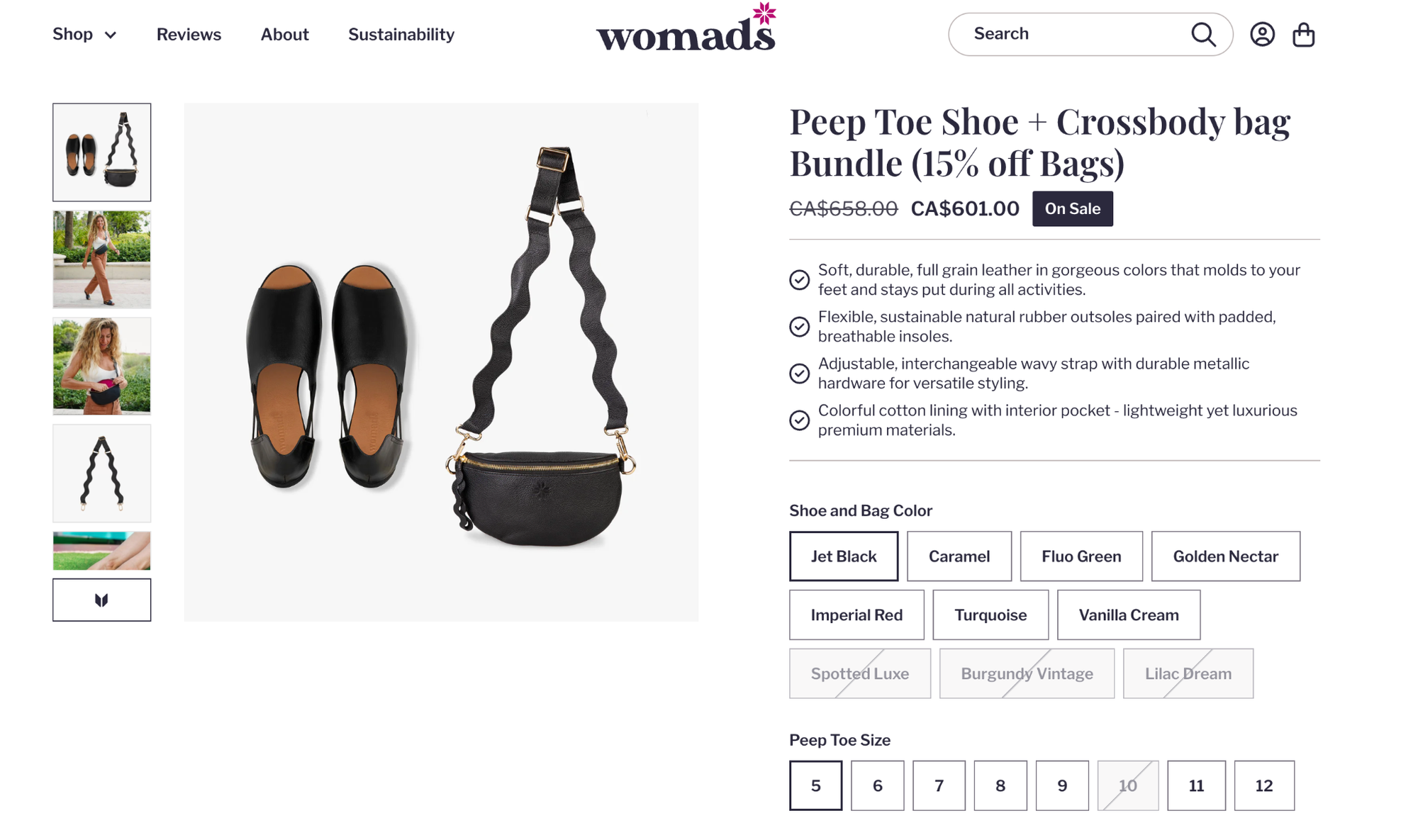
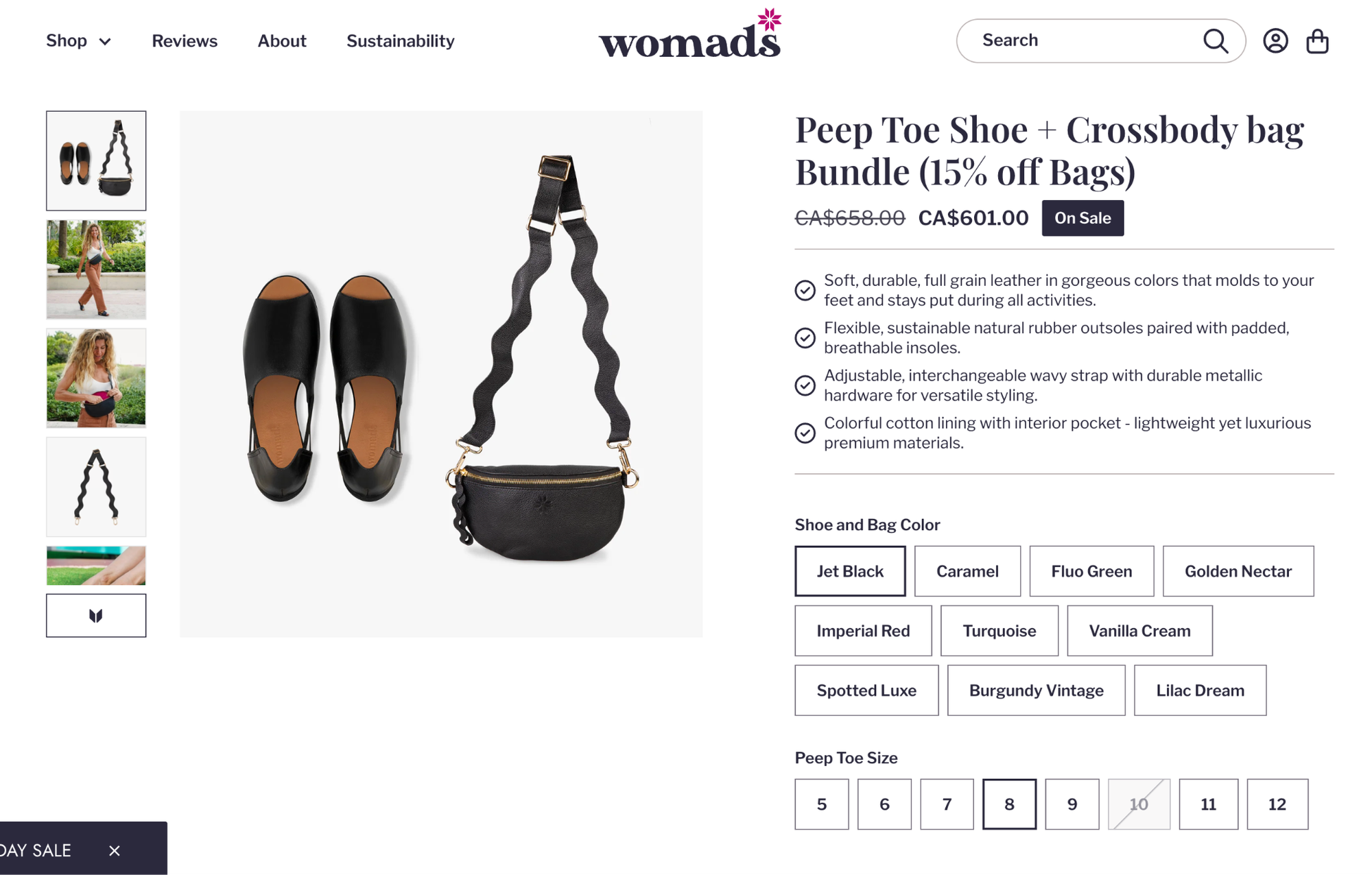
For example, you can see how this works with Womads, a sustainable shoe and bag brand. For this bundle, the size 5 shoes are out of stock for the colors “Spotted Luxe”, “Burgundy Vintage” and “Lilac Dream,” which marks the entire bundle out of stock to purchase.
But as soon as you change the shoe size to 8, these colors are now in stock and available to order:
Dynamic validation ensures only physically fulfillable configurations appear at checkout — critical when offering mix and match experiences or bundled items with many variations.
The Hidden Operational Risk of Multi-Location Fulfillment
Once inventory is distributed across multiple locations, bundle inventory management becomes significantly more complex. A bundle is fulfillable only when all required components are present and pickable in the same location.
Common failure patterns include:
Components stored in different warehouses, preventing complete fulfillment
Regional stocking inconsistencies—one component stocked out on the East Coast but not the West
Safety stock misalignment across sales data and locations
Items defaulting to a primary warehouse while others distribute across the network
Shipping systems selecting suboptimal routes based on outdated inventory data
These discrepancies create downstream impacts such as split shipments, higher shipping rates, delivery delays, and increased customer service volume. Brands with distributed fulfillment must adopt explicit rules governing how bundles should route and under what circumstances they should be considered unavailable.
Pre-Kitting vs. Pick-to-Order: Choosing the Right Fulfillment Model
Bundles can be fulfilled in two ways, and choosing the right model is crucial for maintaining efficiency and accuracy.
Pick-to-Order
Pick-to-order bundles are assembled at the time of fulfillment by selecting each component individually.
Advantages:
Highly flexible
Compatible with multi-location fulfillment
No advance labor required
Risks:
More prone to picking errors
Slower during high-volume periods
Dependent on extremely accurate BOM documentation
Requires the 3PL’s WMS to interpret bundle components correctly
Pick-to-order is most effective for low-volume bundles, customizable bundles, or those with frequently changing components.
Pre-Kitting
Pre-kitted bundles are assembled in advance and stored as ready-to-ship units.
Advantages:
Faster fulfillment
Consistent presentation
Lower picking error rates
Predictable packaging and dimensional weight
Risks:
Upfront labor and storage requirements
Harder to break down returned kits
Sensitive to component stockouts if kitted too early
Pre-kitting is ideal for high-volume bundles, gift sets, subscription shipments, and seasonal campaigns where predictability is essential.
How Shipping Becomes The Largest Hidden Cost in Bundle Operations
Shipping for bundles is frequently miscalculated because Shopify’s shipping engine uses component-level data—weight, dimensions, and origin—to determine rates.
If bundle weight or component dimensions are inaccurate:
Shipping charges at checkout will not match fulfillment charges
Larger-than-expected dimensional weight may trigger carrier surcharges
Bundles may default to oversized packaging
Fulfillment teams may use inconsistent or incorrect packing materials
For bundles with mixed materials (glass, liquids, jars, boxed items), dimensional weight becomes particularly important. A bundle may appear visually compact but still exceed major carriers' dimensional thresholds.
Every bundle should undergo weight and dimensional verification — especially bundles with mixed materials like skincare kits or fragile single product inserts. This includes:
Component weights
Packaging materials
Protective inserts
The combined dimensional footprint
Accurate shipping profiles prevent margin erosion and maintain customer trust.
Returns and Restocking: The Most Overlooked Source of Inventory Discrepancy
Bundles introduce complexity into return workflows because customers may want to return:
The full bundle
Only one part of the bundle
A damaged or partially used component
A subset of items from a customizable configuration
Brands must determine whether they will accept:
Full-bundle returns only
Component-level returns
Conditional returns (e.g., returns allowed only if minimum requirements are met)
Each choice carries operational implications.
Warehouse teams must also be instructed on:
How returned bundles should be broken down
Which components can be restocked
How to handle consumables
How to reassign inventory if pre-kitted bundles are disassembled
Consistent returns logic is essential to preventing long-term inventory drift.
How Simple Bundles Bridges the Gap Between Digital Bundles and Physical Operations
Instead of attempting to force Shopify to behave like a warehouse system—or expecting a 3PL to understand Shopify’s digital configuration—Simple Bundles provides a structured way to align the two.
It works by creating a clear mapping between parent bundle SKUs and their component SKUs, ensuring that the warehouse always sees the actual items required while Shopify maintains the storefront experience merchants want.
How Simple Bundles Supports Inventory Integrity
Simple Bundles offers tools that formalize the essential elements of bundle inventory management:
1. Accurate SKU RelationshipsBundles are broken down into their component SKUs, allowing inventory to be deducted correctly regardless of where it’s stored or how many bundles are purchased.
2. Support for Different Inventory ModelsWhether a brand needs strict location-based inventory, flexible pooled inventory, or dynamic validation for customizable bundles, Simple Bundles can apply the right logic behind the scenes. This allows Shopify to display availability appropriately without overstating stock or creating fulfillment risk.
3. Clear Instructions for Fulfillment PartnersBecause Simple Bundles sends line-item detail to warehouses and 3PLs, pickers always know which items to pack. This eliminates the guesswork that often leads to missing items or incorrect shipments.
4. Predictable Shipping OutcomesBy enabling weight syncing and accurate mapping of component dimensions, Simple Bundles helps ensure that Shopify’s shipping engine reflects the true cost of shipping a bundle.
5. Return and Restocking SupportWith bundles represented as their component SKUs, returns are easier to process. Warehouse teams can restock items correctly, and refund logic becomes consistent with accounting and pricing rules.
Bundle Success Depends on Inventory Integrity, Not just Creativity
Strong merchandising can make a bundle compelling, but only strong operations can make it profitable.
Bundle inventory management is the connective tissue that allows bundling to scale. It aligns digital storefront logic with physical fulfillment realities, ensuring that bundles are:
Accurate
Available
Profitable
Fulfillable
Returnable
Predictable
When inventory architecture, fulfillment workflows, and systems alignment are executed with intent, bundles move from being a revenue tactic to a reliable operational asset.
Off-road and overlanding customers are buying complete upgrades for their rigs. This article explains why kit-based selling dramatically increases AOV for Shopify stores by packaging compatible components into pre-built kits or bundles.
Why bundles are a better way to sell fitment-based kits: merchants can create clean, platform-specific product pages while tracking shared components like lights, brackets, and harnesses at the inventory level.