Basil is the Co-Founder and CTO of Simple Bundles, where he leads product strategy and development. With deep experience building scalable systems for merchants, he specializes in the technical and operational challenges for back-office operations.
Bundling strategies
How off-road and overlanding stores increase AOV by selling kits
Off-road and overlanding customers are buying complete upgrades for their rigs. This article explains why kit-based selling dramatically increases AOV for Shopify stores by packaging compatible components into pre-built kits or bundles.
Basil is the Co-Founder and CTO of Simple Bundles, where he leads product strategy and development. With deep experience building scalable systems for merchants, he specializes in the technical and operational challenges for back-office operations.
A clothing store sells a shirt. An off-road shop sells a transformation.
That's the difference most ecommerce advice misses. When someone lands on your overlanding store, they're not shopping for a single fog light. They're shopping for the complete fog light upgrade for their rig, with the brackets, harness, and pods all matched to their platform.
The product isn't a part. It's a kit that turns their truck into something else.
And if you're not selling kits, you're leaving serious money on the table.
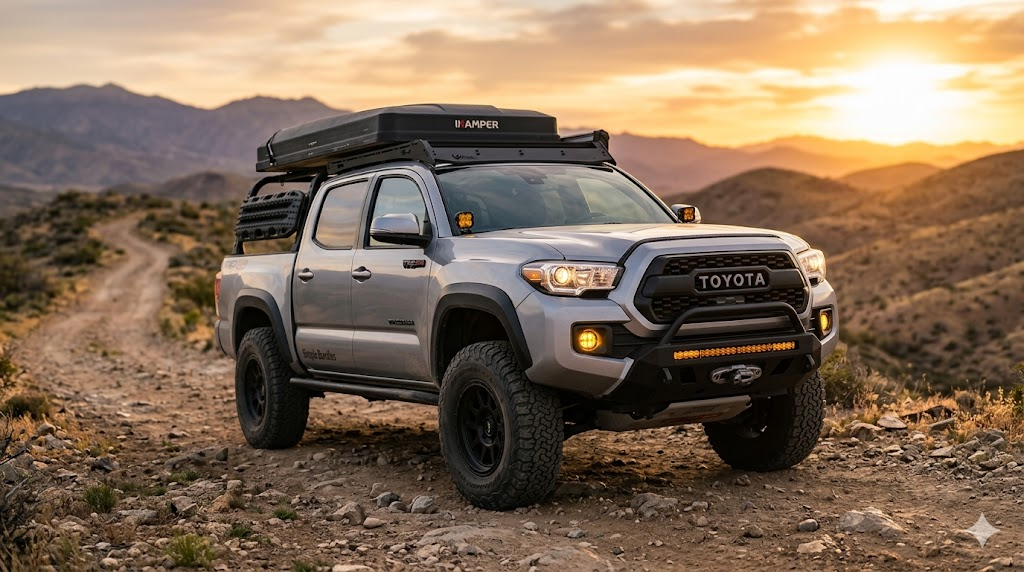
A complete build, not a parts list. This is what off-road customers are shopping for.
The AOV gap between parts and kits
Here's the math from real off-road stores:
A single fog light pod: $150
The complete fog light upgrade kit (pods + brackets + harness + switch): $950
Same customer, same intent, 6x the order value. The difference is whether you made it easy for them to buy everything they need in one click.
Off-road and overlanding customers aren't bargain hunters picking up one piece at a time. They're building rigs. They want the whole solution. When you sell components separately, you force them to figure out compatibility, source the right brackets, match the harness to their vehicle. Some will do that work. Most will bounce to whoever already packaged it as a kit.
The competitor with a kit page wins the sale and increases AOV.
Why kits work for off-road and overlanding stores
Off-road, overlanding, and truck accessories hit a sweet spot for bundling:
Build culture: These customers want to configure. They want to pick their light pattern, their bumper style, their rack setup. But they want to configure within a framework that guarantees compatibility. Kits give them choices without making them engineers.
High AOV, high stakes: These are $500 to $3,500 orders. A botched component or missing bracket isn't a minor annoyance. It's a rig that doesn't get finished before the weekend trip. One angry forum post can cost you months of customers. Kits reduce errors because you've already figured out what works together.
Platform-specific fitment: Parts differ by year, make, model, and trim. A "fog light kit" isn't one product if you're serving F-150, Super Duty, Tacoma, and 4Runner owners. Kits let you build platform-specific packages while pulling from the same component inventory.
Aftermarket brand mixing: Unlike OEM where a part number means one thing, overlanding builds mix brands constantly. Baja Designs lights on CBI brackets with a manufacturer-specific harness. Kits are how you sell that curated combination instead of hoping customers piece it together.
Two types of kits (and why you need both)
After looking at how successful off-road stores use bundling, there are two main types of bundles to consider:
The pre-built kit
This is your "complete bumper install kit" or your "rooftop tent mounting package." One click, done.
For example, a heavy-duty diesel shop may sell manifold install kits this way. $850 to $2,675 depending on the package level. Manifold, ARP hardware, gaskets, spacers. The customer doesn't need to research compatibility. The store already validated the build.
In Simple Bundles, this is the standard bundle type.
The configurator
The customer picks their options within a framework you've defined.
Most successful off-road stores run both. Some products are "here's the proven build." Others are "spec it your way."
The operations problem underneath the AOV win
When you sell a kit, you're really selling an assembly of components. Those components might also sell individually. They might appear in multiple kits. The moment you start tracking inventory at the kit level instead of the component level, you're guessing.
Without mentioning names, I took a look in our customer dataset and saw one overlanding store's data showed this clearly:
312 sellable kit combinations across just 7 bundle products, all drawing from 77 underlying components. The same bracket might appear in 5 different kits. The same pod in 8.
If you track those as separate inventory pools, you'll oversell within a week. If you track them as one component inventory that all kits pull from, you see reality.
The other operational win is fulfillment clarity.
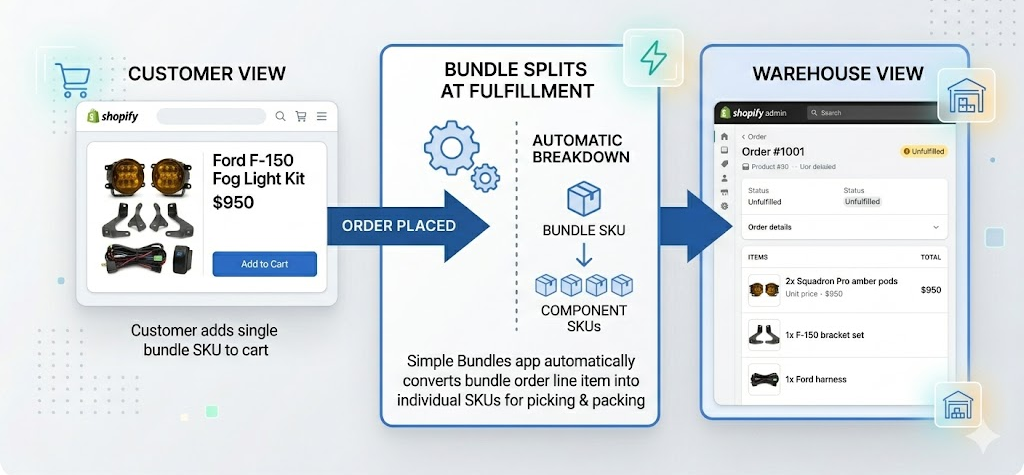
A "fog light upgrade kit" is a marketing concept. The warehouse picks pods, brackets, and a harness. Bundling apps that split the kit into components at fulfillment mean pickers see exactly what goes in the box.
The kit disappears at fulfillment. The warehouse sees pickable components.
What "selling kits" actually requires
You can fake kits with product descriptions that say "includes brackets and harness." But that doesn't solve anything. The customer still sees one Add to Cart button for one SKU. Your inventory still tracks one number. Your warehouse still has to interpret what "the kit" means.
Real kit selling requires:
Component-level inventory sync: When the kit sells, the right child SKUs decrement. Your rarest component constrains availability automatically.
Variant generation at scale: If your configurator creates 196 combinations, those combinations need to exist as purchasable options without you building 196 product pages.
Fulfillment that shows actual parts: The warehouse doesn't pick "a kit." They pick what's in the kit. The bundle structure should disappear at the order level, replaced by pickable line items.
Platform-specific product pages: Your 2023 F-150 kit page should be a real page that ranks for "2023 F-150 fog light kit," not a variant buried in a generic listing.
That's what Simple Bundles handles for Shopify stores. The kit is the merchandising layer. The components are the operational layer. The two stay connected without manual reconciliation.
The bottom line on kit-based AOV
Off-road and overlanding stores that sell kits typically see 3-5x higher AOV than stores selling the same components separately. That's not because kits have higher margins (they often don't). It's because:
Customers buy everything they need instead of one piece
Kits answer the "what do I actually need?" question that otherwise kills conversion
Kit pages rank for platform-specific searches that component pages can't win
The checkout friction is one click, not five separate Add to Cart decisions
The stores winning in this vertical aren't winning on price. They're winning on making the build easy.
If you're selling off-road or overlanding gear on Shopify and want to see how this works for your catalog, Simple Bundles has a free trial to test both pre-built kits and Infinite Options configurators with your actual products.
Build a bundle in under 5 minutes
Over 25,000 Shopify merchants use Simple Bundles to sell more per order.
Why bundles are a better way to sell fitment-based kits: merchants can create clean, platform-specific product pages while tracking shared components like lights, brackets, and harnesses at the inventory level.
Product bundle pricing is one of the most effective ways to increase average order value. This guide explores the psychology and economics behind successful bundling, including why bundles increase perceived value, how top brands structure their offers, and the pricing frameworks that drive results.