Basil is the Co-Founder and CTO of Simple Bundles, where he leads product strategy and development. With deep experience building scalable systems for merchants, he specializes in the technical and operational challenges for back-office operations.
Bundling strategies
How to sell automotive vehicle parts on Shopify without drowning in variants
Why bundles are a better way to sell fitment-based kits: merchants can create clean, platform-specific product pages while tracking shared components like lights, brackets, and harnesses at the inventory level.
Basil is the Co-Founder and CTO of Simple Bundles, where he leads product strategy and development. With deep experience building scalable systems for merchants, he specializes in the technical and operational challenges for back-office operations.
If you sell aftermarket parts on Shopify you already know product bundle math is difficult, to say the least.
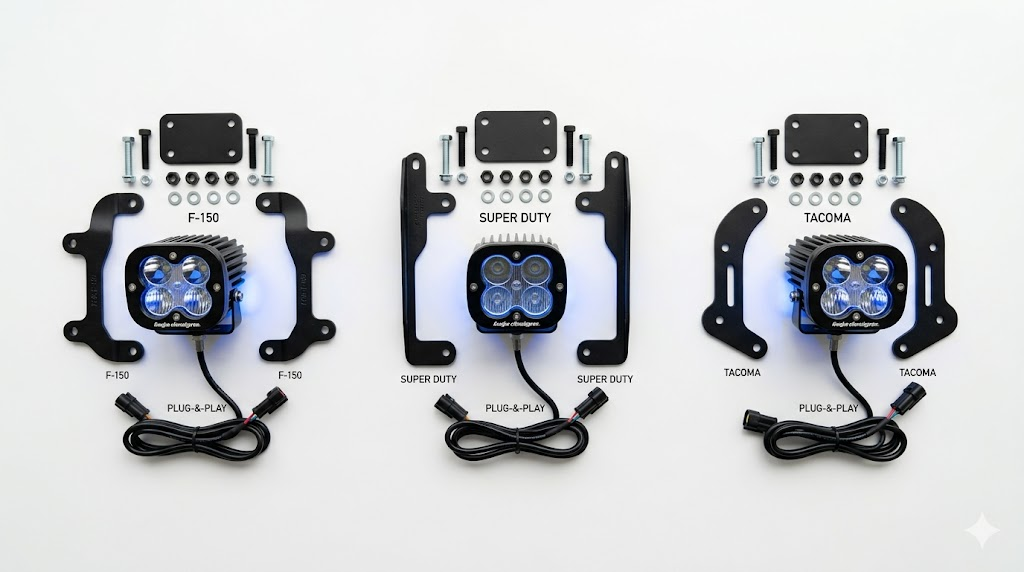
A fog light kit isn't one product. It's a different kit for every platform: 2021+ F-150, 2023+ Super Duty, Bronco Raptor, Tacoma TRD Pro. Same lights, different brackets. Same harness concept, different connector. Same product page in your head, but Shopify wants you to build four.
...Or forty. Or four hundred.
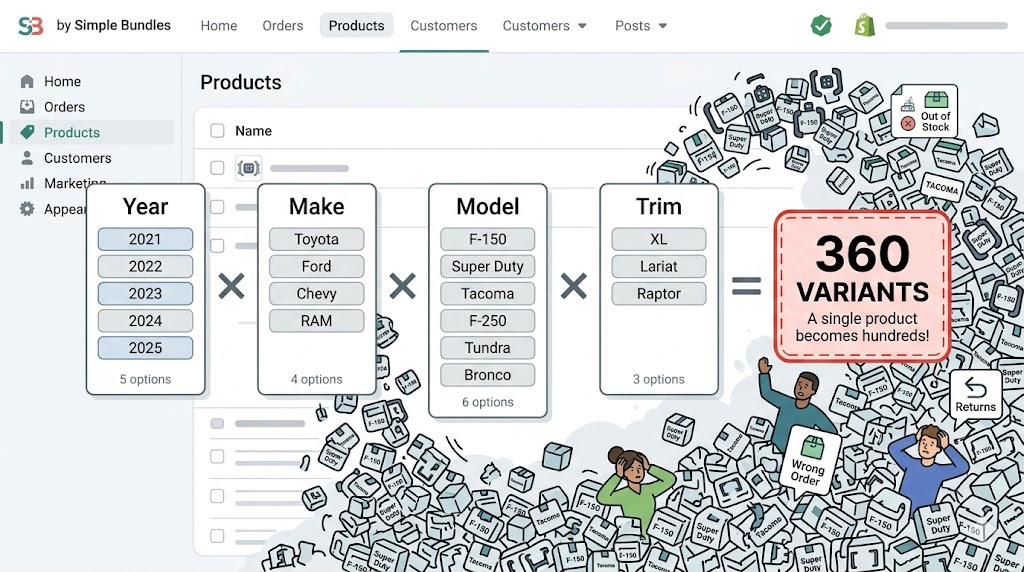
That's the fitment problem. Parts are sold by year, make, model, and trim. Shopify's native product model assumes you're selling t-shirts in small, medium, and large. It breaks the moment your inventory is organized by vehicle platform.
Same product, different fitment: one fog light kit adapted for three truck platforms.
Why Shopify variants don't scale for fitment
Shopify gives you three option slots per product: Color, size, material. For a t-shirt, that's plenty.
For aftermarket parts, you need year, make, model, and often trim or engine type. That's four dimensions before you've even added color options. And Shopify's variant system treats every combination as a separate SKU you have to manage.
One off-road lighting company tried to build this natively. A single fog light upgrade kit across 7 truck platforms, with 4 light pattern options, times 2 harness lengths.
Just to do the math for you, that's 56 variants per platform, 392 total. Shopify's old 100-variant limit made it impossible. Even the new 2,000-variant limit doesn't solve the real problem: you're now managing 392 inventory records for what your warehouse sees as maybe 15 actual components.
The variant approach doesn't just hit limits. It creates operational chaos.
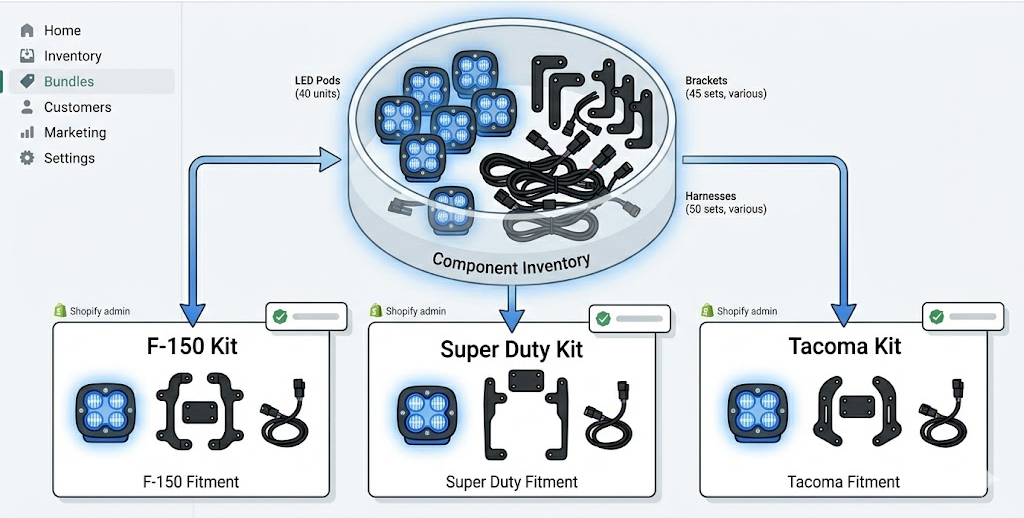
Instead, I'm going to show you how to make the kit as the product and the components are inventory.
So rather than building one massive product with 392 variants, you build platform-specific bundles. Each bundle pulls from the same component pool but assembles the right combination for that vehicle.
2021+ F-150 Fog Light Kit: Baja Designs Squadron pods + F-150-specific brackets + Ford harness adapter 2023+ Super Duty Fog Light Kit: Same pods + Super Duty brackets + different harness Bronco Raptor Fog Light Kit: Same pods + Bronco brackets + Bronco harness
Three bundles, each with its own product page optimized for that platform. But behind the scenes, they all pull from the same inventory of pods, brackets, and harnesses.
When you restock Squadron pods, all three bundles update automatically. When one bracket variant sells out, only the affected platform goes out of stock.
One component pool, multiple platform-specific bundles. Shared inventory, clean product pages.
How this works for configurators
Some fitment scenarios need customer input. Maybe you sell a grille light kit where the customer picks their light pattern (spot, flood, combo, amber) and their vehicle platform determines which mounting hardware ships.
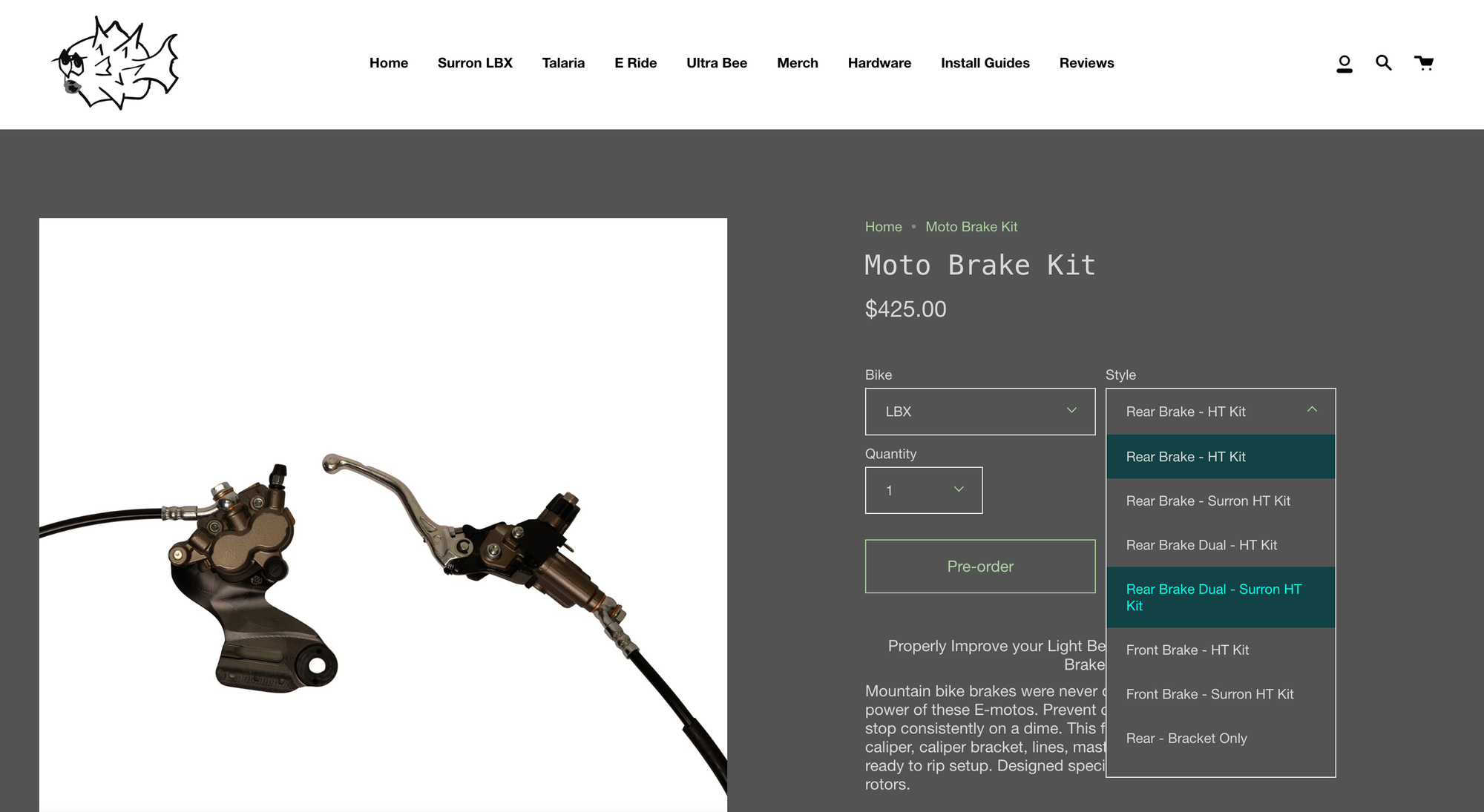
The customer selects their vehicle from a dropdown. The bundle logic maps that selection to the right parts. The final combination assembles from your component inventory.
Prickly Motorsports did this with its Moto Brake Kit:
One overlanding accessories store runs exactly this setup. 196 possible combinations from 7 underlying components. The customer experiences a simple two-step selection. The warehouse picks the right parts. No one had to build 196 separate product pages.
The inventory reality check
Bundle availability is constrained by your rarest component.
If you have 50 Squadron pods but only 3 Bronco-specific brackets left, you can only sell 3 Bronco kits. Without component-level inventory tracking, Shopify doesn't know that. You'll oversell, then scramble to explain why a $950 kit is delayed waiting on a $40 bracket.
That's overselling at scale, and it happens when bundles don't track component reality.
The fix is straightforward: bundles that sync to component inventory in real time. When the kit sells, the right child SKUs decrement. When one component constrains availability, the bundle reflects it at checkout.
When to use bundles vs variants for fitment
Not every fitment scenario needs bundles. Here's a decision framework to help guide you:
Use Shopify variants when
You have fewer than 3 fitment dimensions (year and make only, no trim variations)
Each variant is truly a different SKU with its own inventory (not assembled from components)
You're under 100 total combinations
Use bundles when
Components are shared across platforms (same lights, different brackets)
You need more than 3 option dimensions
Inventory should track at the component level, not the assembled-kit level
You want platform-specific product pages for SEO
Most aftermarket parts stores land in bundle territory the moment they're selling kits rather than individual components.
The SEO advantage nobody mentions
Aside from keeping inventory clean, there's a quiet benefit to having dedicated bundles: platform-specific bundles mean platform-specific product pages.
When someone Googles "2023 F-150 fog light kit," your dedicated F-150 bundle page can rank. If you'd built everything as variants on one generic "fog light kit" page, you're competing against yourself and diluting your relevance signal.
Aftermarket parts customers search by vehicle. Bundles let you build pages that match how they search.
Build fitment around bundles, not variants
Fitment is where Shopify’s native variant model starts to fight the way aftermarket parts are actually sold.
That’s why Simple Bundles is a better fit for automotive and aftermarket parts stores. Instead of forcing every year, make, model, trim, harness, bracket, and light pattern into one massive variant tree, you can build clean, platform-specific bundle pages that pull from the same underlying component inventory.
Off-road and overlanding customers are buying complete upgrades for their rigs. This article explains why kit-based selling dramatically increases AOV for Shopify stores by packaging compatible components into pre-built kits or bundles.
Product bundle pricing is one of the most effective ways to increase average order value. This guide explores the psychology and economics behind successful bundling, including why bundles increase perceived value, how top brands structure their offers, and the pricing frameworks that drive results.