Ashley is a writer focused on SaaS, ecommerce, and the creator economy, helping brands turn complex ideas into clear, actionable content and sharing practical guidance to help merchants grow.
Shopify tips
7 omnichannel retail trends reshaping ecommerce in 2026
AI search, predictive inventory, social commerce, and connected in-store experiences are reshaping retail. Here are the top omnichannel retail trends brands need to know for 2026.
Ashley is a writer focused on SaaS, ecommerce, and the creator economy, helping brands turn complex ideas into clear, actionable content and sharing practical guidance to help merchants grow.
Omnichannel retail is evolving fast.
Consumers now shop across at least six touchpoints before making a purchase, while AI-powered discovery tools like ChatGPT and Google AI Overviews are changing how shoppers find products online.
At the same time, retailers are under pressure to unify pricing, inventory, fulfillment, and customer experiences across ecommerce, social commerce, mobile apps, and physical stores.
From predictive inventory systems to AI-driven product discovery, these are the biggest omnichannel retail trends shaping 2026.
Key Omnichannel Retail Trends for 2026
AI-powered product discovery is replacing traditional search
Predictive inventory systems are reducing stockouts
Retailers are unifying pricing across channels
Physical stores are becoming experiential brand hubs
Social commerce is accelerating mobile purchasing
Brands are optimizing for AI search engines
Retailers are investing in unified customer data systems
1. AI search is reshaping omnichannel retail
The biggest shift in omnichannel retail isn’t happening in stores. It’s happening in search.
Just a year ago, product discovery looked very different than it does today. Most purchasing journeys still begin the same way: with an online search. In 2024, 49% of shoppers started their journey on a search engine, a figure that remained largely consistent in 2025 at 44%.
But while the starting point hasn’t changed, what shoppers see next has.
Today, search results look fundamentally different. AI-powered overviews now sit at the top of many results pages, answering questions directly and pushing traditional links further down.
Since launching AI Overviews, Google says there’s been a “profound shift” in how people use Search. Shoppers are asking longer, more complex questions, driven by changing shopping behavior, and receiving AI-driven answers instead of scanning a list of links.
At the same time, a growing group of shoppers is starting product research outside traditional search engines altogether. Tools powered by artificial intelligence, including ChatGPT and Claude, are becoming entry points for discovery, especially for comparison-heavy queries and personalized recommendations, signaling a broader shift in customer behavior and demographics.
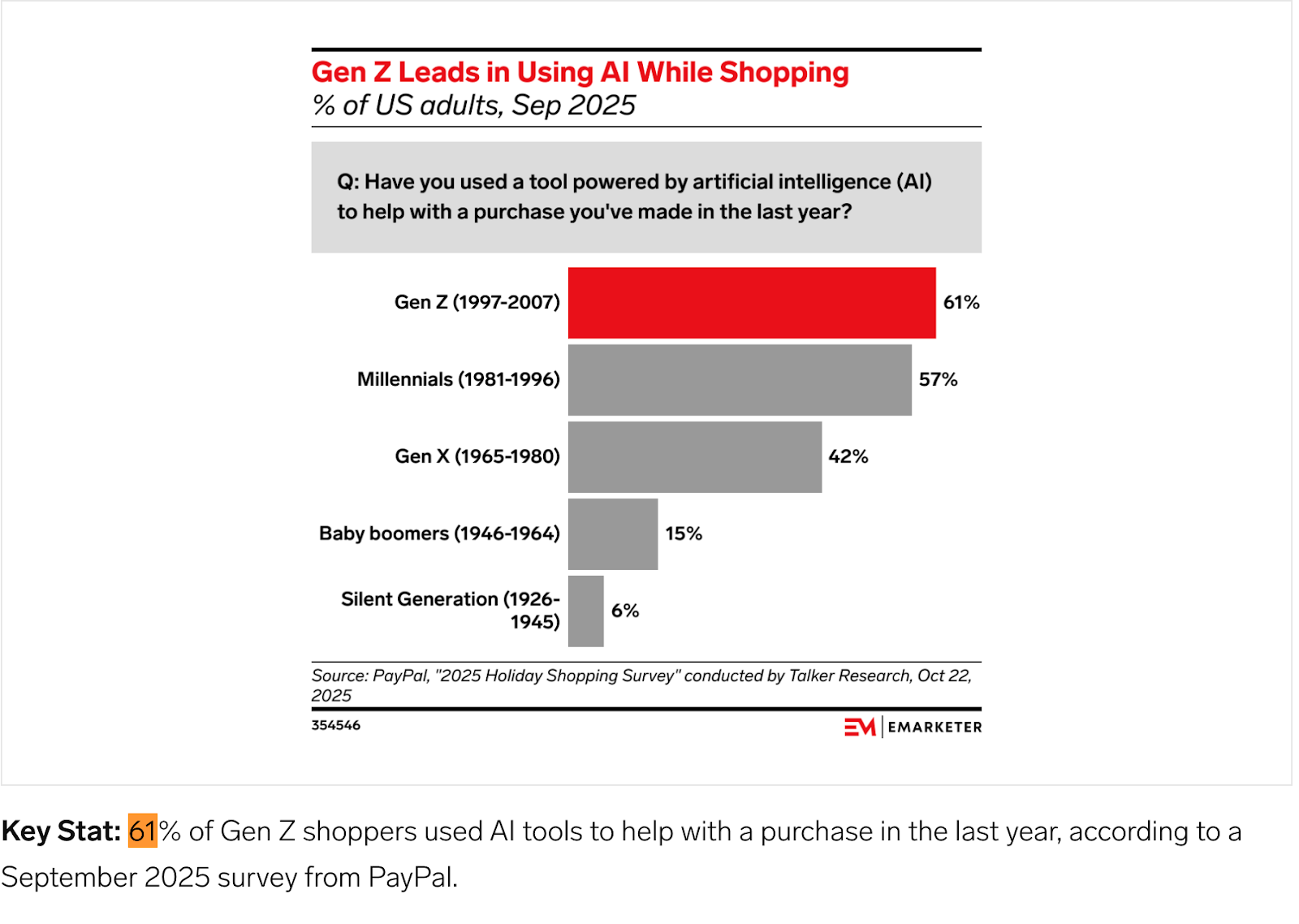
Younger shoppers are already leaning into this behavior. In a recent survey, 61% of Gen Z consumers said they’ve used AI tools to help with a purchase in the past year.
As Eli Weiss, VP of Advocacy at Yotpo, puts it: “People aren’t searching the way they used to. They’re asking. When someone types ‘best cleanser for dry skin’ into ChatGPT or Claude, they aren’t scrolling through a dozen links. They’re getting an answer with specific products, reviews, and retailers without ever touching Google or Amazon.”
AI Is changing product discovery
Search is becoming conversational.
According to Google, shoppers are asking longer, more complex questions than ever before. At the same time, younger consumers are increasingly comfortable using AI tools during the buying process.
In a recent survey, 61% of Gen Z shoppers said they used AI tools to help make purchasing decisions over the past year.
That means brands are no longer competing only for rankings in traditional search results. They’re now competing to become trusted recommendations inside AI-generated answers.
And AI systems evaluate brands differently than traditional search engines.
Instead of relying heavily on backlinks and keywords alone, AI-powered shopping tools prioritize:
detailed product information
consistent brand data
authentic customer reviews
expert recommendations
structured product feeds
retailer credibility
real-world user sentiment
In other words, brands that provide the clearest and most trustworthy information are more likely to surface in AI-driven recommendations.
How smart brands are adapting
As Eli Weiss points out in his newsletter, AI-driven discovery is rewarding a very different set of signals than traditional social-first marketing. Brands that win are those with strong customer engagement, credible data, and consistent brand experience across channels.
He points to Patagonia and Gymshark as an example.
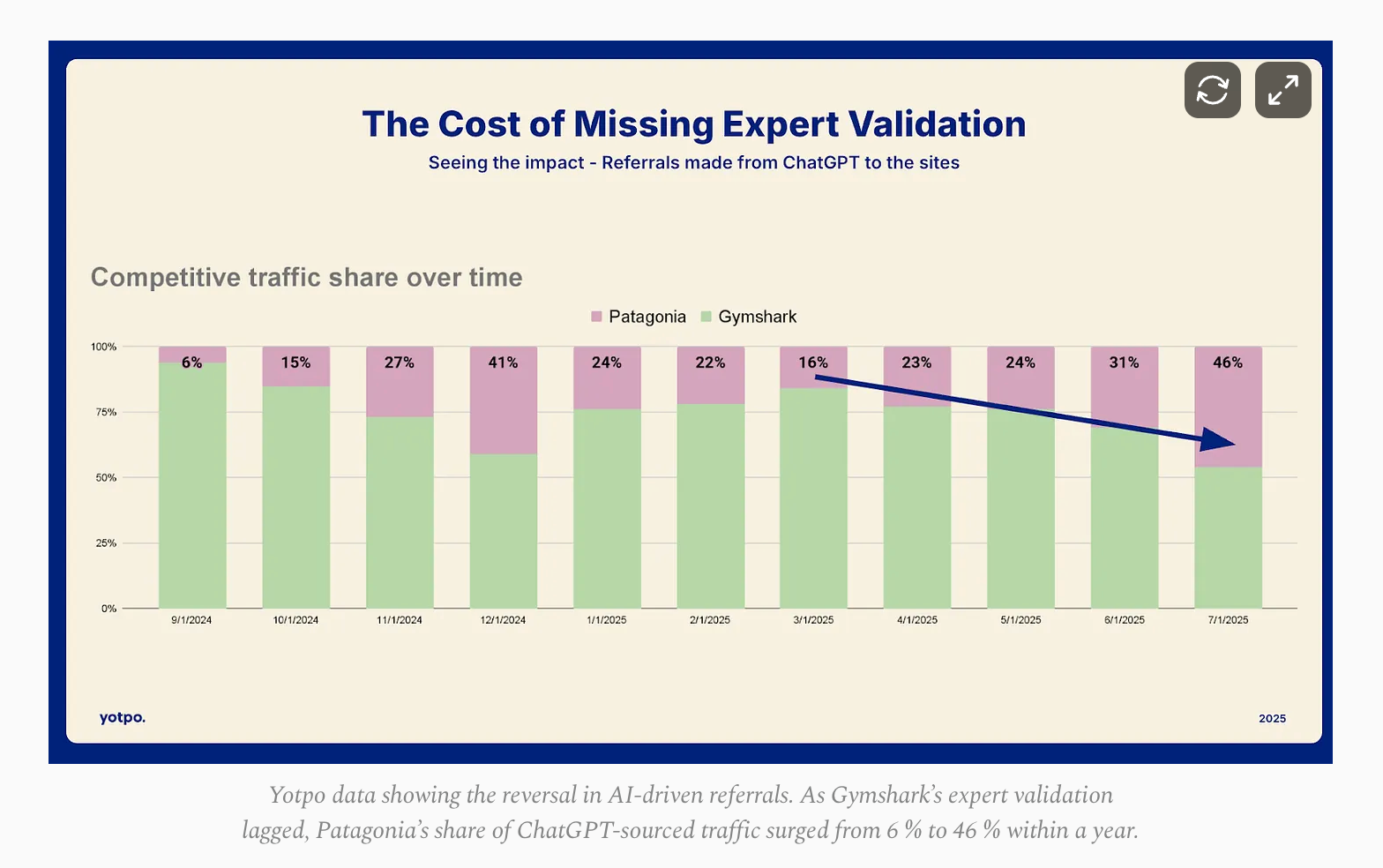
A few years ago, Gymshark dominated Patagonia. But today, in terms of showing up in AI-search, Patagonia now leads.
According to Yotpo data shared by Weiss, Patagonia appears in roughly 94% of AI-generated recommendations for outdoor clothing and gear. Referral data tells the same story: traffic from ChatGPT to Gymshark’s site dropped from 94% to just over 50% in the past year, while Patagonia climbed from 6% to 46%.
Weiss continues by bringing in analysis from Yotpo CEO Tomer Tagrin, who breaks Patagonia’s advantage down into three factors:
Brand data. Detailed product specs, materials, sustainability information, and clean structured data that AI systems can easily parse.
User sentiment. Long, specific reviews that describe real-world use instead of one-line reactions.
Expert validation. Coverage from trusted publications like Outside Magazine, Runner’s World, and Consumer Reports.
Together, these signals make Patagonia easier for AI models to trust and more likely to recommend.
What retailers can do to get ahead
Retailers must optimize for AI discovery.
In short, brands must integrate AI discoverability into their omnichannel strategy. Weiss gives us 3 strategies to stay ahead:
Structure your product data. Clean schema markup, accurate specs, and consistent feeds so AI can understand and surface your products.
Cultivate rich user reviews. Long, descriptive reviews give AI models meaningful content to pull into responses.
Build authoritative external signals. Expert validation, review sites, and media mentions help AI models trust your brand more.
The brands that win in 2026 will treat AI discovery as part of their broader omnichannel retail strategy.
2. Retailers are adopting predictive AI tools to forecast inventory by channel
Search and product discovery aren’t the only places where AI is making a splash in the retail world. Retailers are now using AI to run tighter operations across both online and physical stores.
Instead of scrambling to meet demand after the fact, AI tools predict what customers will want, how much they want, and when. Predictive AI tools help retailers forecast inventory, which leads to leaner inventory, fewer stockouts, and less capital tied up in products that aren’t moving.
This matters because omnichannel retail breaks down quickly when inventory data is out of sync. If online demand spikes while stores are overstocked (or vice versa), customers feel the friction immediately.
But these tools don’t only reduce friction. They actively help reduce costs and improve efficiencies. According to industry analysis, companies that implement AI-powered inventory management have reduced inventory costs by 10–15% while improving supply chain efficiency by 20–25%.
How brands are adapting
Warby Parker is a great example of a brand benefiting from AI. It uses AI forecasting to manage inventory across its ecommerce site and physical retail locations. The system analyzes data from sales, website traffic, and broader demand signals to predict which products—down to specific frames, sizes, and colors—will be needed at each location.
By doing this, the brand improved forecasting accuracy, reduced stockouts, and streamlined pickup options like BOPIS and curbside pickup.
In fact, Warby Parker has reduced stockouts by up to 30%, cut overstocking by 25%, and improved forecasting accuracy by 40%.
The AI system also allows the brand to react faster to changes in demand, adjusting inventory before customers feel the impact.
What retailers can do
You don’t need a massive AI overhaul to get value. Start with small, operational wins that compound over time. Here’s how:
Start small with AI forecasting tools. Many Shopify-compatible apps now offer predictive demand planning. Use them to spot trends by location, season, or product category before demand spikes or drops.
Connect your sales channels. Sync POS, ecommerce, and fulfillment data in the cloud so that inventory updates everywhere at once.
Automate repeat decisions. Set rules for reorders, returns, and low-stock alerts to reduce manual work and avoid preventable stock issues.
Treat data like an employee. Review reports regularly to spot patterns, identify slow movers, and catch emerging local demand early before it turns into lost sales or excess inventory.
3. Retailers are standardizing commerce logic across channels
We’ve heard it a million times: shoppers (90% of them) want the same experiences everywhere.
When ecommerce and brick-and-mortar stores operate in silos, retailers lose trust, customer loyalty, and revenue. Treating all channels as a single omnichannel shopping ecosystem creates a seamless experience.
Even though creating a seamless customer journey is basically an omnichannel retail commandment, Marco Loguercio explains that some retailers still treat ecommerce and in-store as siloed, competing channels.
Too many companies still treat e-commerce and physical stores as competitors. On The Search Session, @marcologuercio explains why this mindset kills omnichannel opportunities.
If a user knows a shop 2 km away has their size in stock, they’ll buy there in minutes. Retailers need… pic.twitter.com/WWuw67rFqO
The best omnichannel retailers prioritize operational consistency across channels. They’re working hard to ensure that whatever a shopper sees (or can do) online works the same way in-store and vice versa.
Allow me to share a personal example of what I mean. I’m headed to the Amazonian jungle with my son next month (woo hoo!). This means my son and I needed some clothes that would protect us from the sun and mosquitoes while also being breathable.
We took an afternoon to shop at a popular outdoor retailer. We found some AWESOME pants in the store for $14.99 (score!), but there was only one pair left in my son’s size. When we went online to buy the exact same pants, they were $59.99.
As a consumer, this is how I feel about that:
So, I did what any smart consumer would do. I searched for a dupe on Amazon—right in the other retailer's store and purchased those instead.
This is the opposite of what retailers want, but it’s solvable if we apply Loguercio’s logic and treat all sales channels as a single channel.
Consistency starts with your systems. When your POS and online storefront share the same logic, it becomes much easier to keep pricing, promotions, and bundles aligned across channels.
How brands are adapting
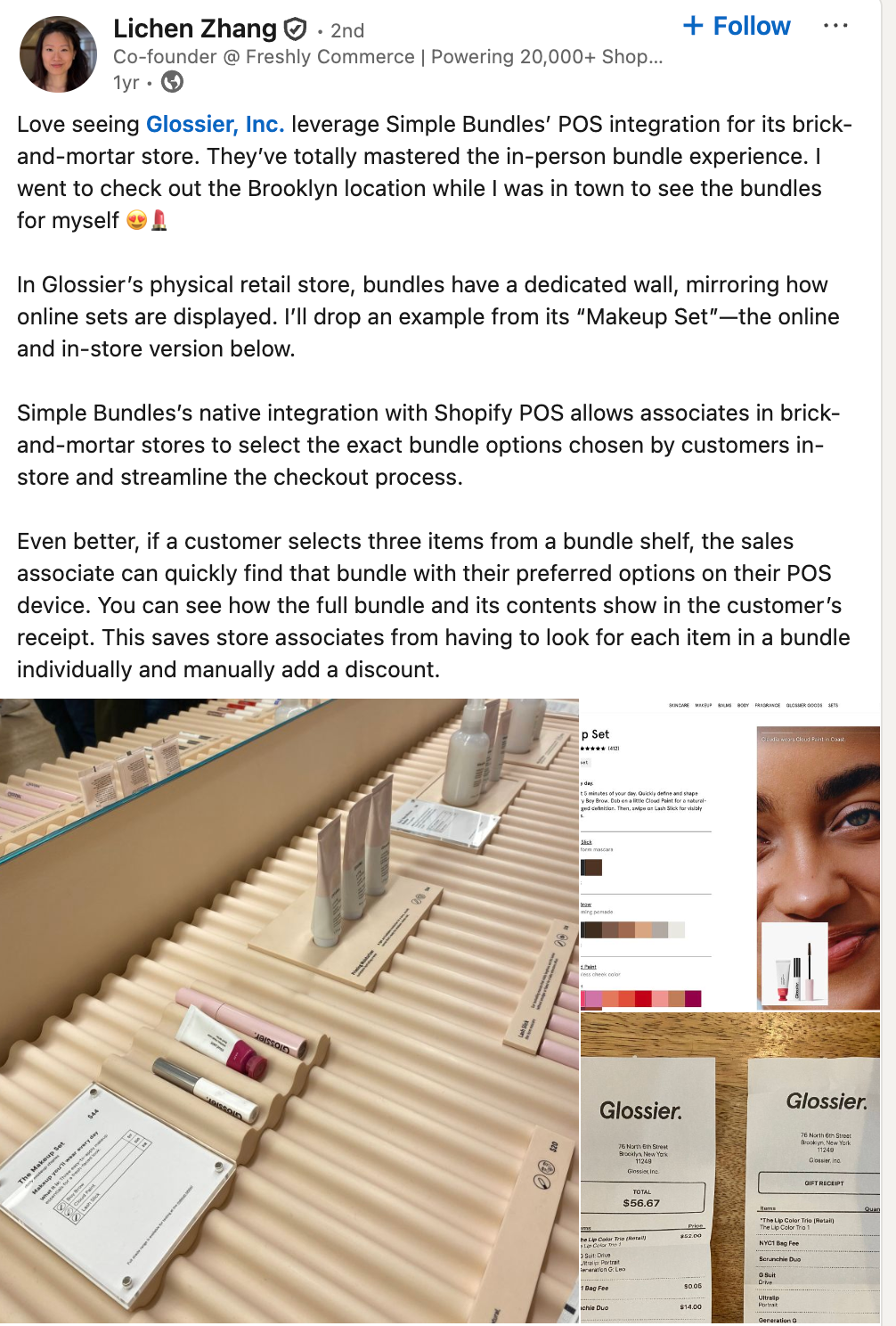
Glossier has mastered the in-person bundle experience. And the best part? It mirrors what shoppers see online.
According to Freshly Commerce’s Co-founder, Lichen Zhang, Glossier’s brick-and-mortar stores feature dedicated bundle displays that mirror the sets customers see online. Its “Makeup Set” bundles use the same products, pricing, and presentation whether shoppers are browsing the website or standing in the store.
Behind the scenes, this works because bundle logic carries through to checkout. With Simple Bundles’ native integration with Shopify POS, store associates can select the same bundle options customers choose in-store and apply them instantly at the register.
If a customer picks three items from a bundle display, the associate can pull up the full bundle—with the correct options—directly on their POS device. The receipt automatically reflects the bundle and its contents, without manually adding each item or calculating discounts.
That consistency saves time for store staff, reduces checkout friction, and delivers exactly what shoppers expect: the same experience, no matter where they buy.
What retailers can do
Consistency comes from running the same commerce rules everywhere customers buy online, in-store, and beyond. Here’s what to do:
Unify merchandising logic across channels. Bundles, pricing rules, and promotions should live in one system and surface everywhere—on your online storefront and at the POS.
Keep inventory in sync. Shared inventory data across ecommerce and POS prevents bundle breakage, pricing mismatches, and out-of-stock surprises at checkout.
Use bundle performance as insight. Identify top-performing combinations online and translate them into in-store displays, signage, and associate recommendations.
4. Stores are becoming experience hubs that extend a brand’s digital identity
Retailers have spent the last few years pouring creative energy into building their brands online.
We’ve seen Duo the owl light up TikTok with his antics (oddly, they’re rarely related to language learning). Ryanair’s social team turned budget airline announcements into self-aware comedy sketches. And Princess Polly built a TikTok-native aesthetic so recognizable that its content feels like it came from a single creator, not a brand.
And people are here for it. Consumers regularly and engage with brands on social media. And social commerce revenue is expected to reach $1 trillion globally by 2028.
While social commerce is flooding the retail world, there’s another interesting (and perhaps unexpected) new trend.
But, not in a 1990s kind of way. You’re not going to pop into your favorite retail store and see blank walls and a few cute outfits. You’ll see full-on extensions of a brand’s digital identities, including TikTok aesthetics, membership perks, app-linked fitting rooms, etc.
Now, instead of asking, “How do we sell more in-store?” leading brands are asking, “How does this space deepen connection, build community, and reinforce everything customers already see online?”
While physical stores are built for shopping, they’re also built for interaction.
How brands are adapting
Skims is a great example of what this looks like when it’s done well.
The brand launched in 2019 as a digital-first powerhouse. Social buzz, inclusive sizing, celebrity-driven campaigns—it all worked. Skims quickly became one of those brands people felt like they already knew before ever buying.
By the end of 2025, the brand hit a $5 billion valuation and built a growing physical footprint, with 18 stores across the U.S. and two in Mexico, plus a flagship London store on the way. Skims has even said it wants to become a predominantly physical business.
These new locations are perfect examples of extensions of Skim’s online presence. You’ll see the same aesthetic, same tone, same sense of familiarity that customers already get from social and online channels.
And the strategy is working. Skims grew from $500 million in revenue in 2022 to $750 million in 2023, with projections to cross $1 billion in 2025.
What retailers can do
Looking to move your online store offline, or do you want to spruce up your physical locations? Here are some things to try:
Design stores with intention. Create clear experience zones for discovery, try-ons, events, and community.
Treat the store as a media channel. Capture UGC, influencer livestreams, and in-store moments and feed them back into social, email, and SMS.
Connect experiences to identity. Link in-store interactions to memberships, CRMs, apps, and customer profiles so physical engagement fuels long-term relationships.
Integrate your stack. Connect in-store interactions to CRM, memberships, and loyalty programs.
5. Retailers are making the online shopping experience as tangible as possible
Yes, retailers are making strides to improve their in-store shopping experiences.
The opposite is also true. Customers now expect digital shopping to be as tactile, social, and personal as being in a physical store.
And many brands are making this happen. How? By investing in experiences that collapse the distance between inspiration and purchase (we’ll talk about these in a minute).
How brands are adapting
If you’ve ever shopped Rare Beauty online, you’ve seen how easy they make it to choose makeup without stepping into a store.
Here are some of the ways the brand makes this possible:
Creator videos as product demos. Influencer content shows real application, texture, and wear across different skin tones.
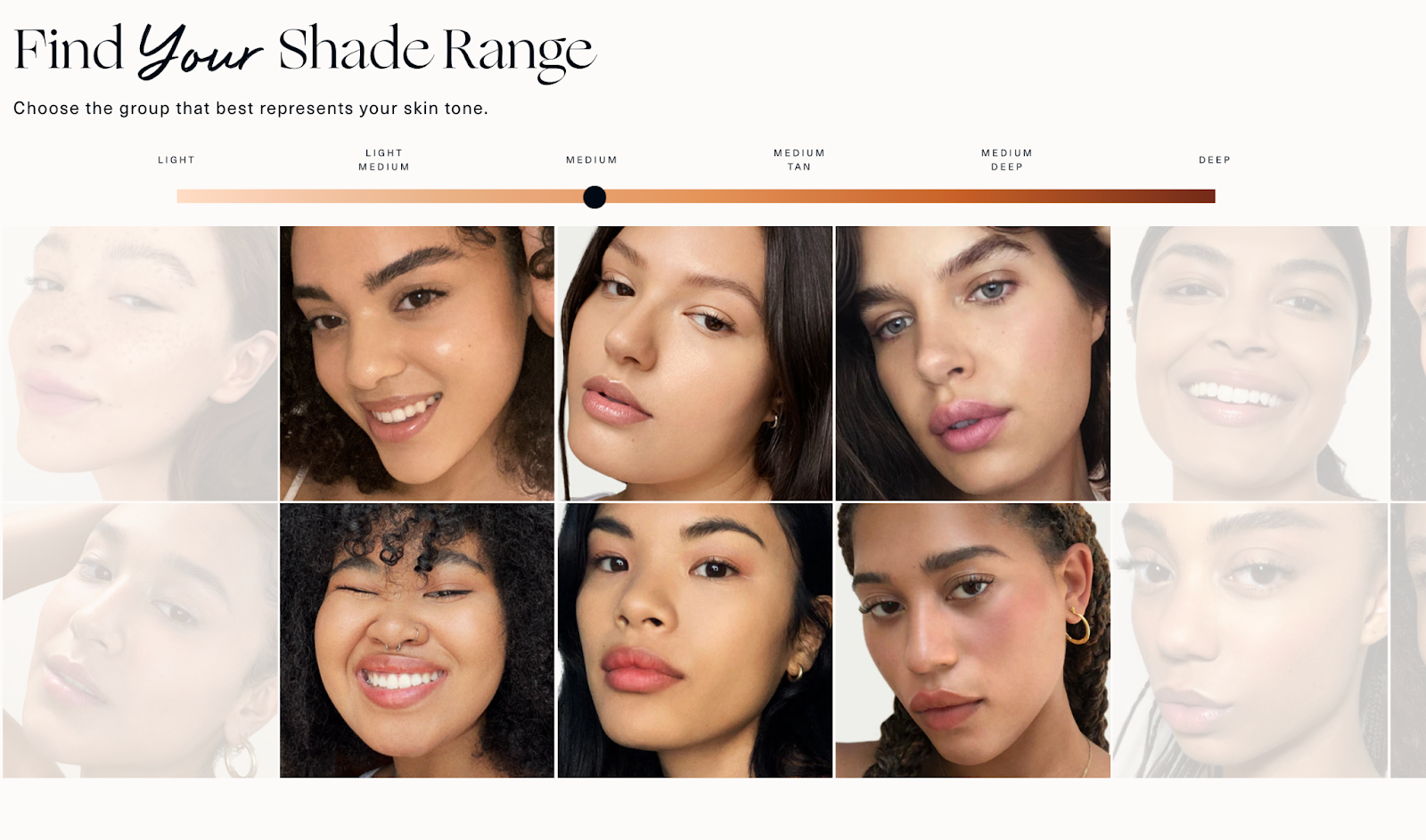
Built-in shade matching guidance. Shoppers get clear guidance on choosing the right shade without guessing or overthinking.
Customer reviews that add context. Reviews surface how products perform in real life, not just how they look in studio photos.
Direct path to mobile checkout. Shoppers can move from social content to purchase with minimal friction.
What retailers can do
Here’s how to make your digital experience as tactile as your physical experiences:
Refine your digital shelf. Use high-quality images, clear product descriptions, and include the kind of details a shopper would get by picking the product up in-store—size, texture, fit, finish, and use cases.
Test immersive media. AR try-ons and 3D views can reduce hesitation and returns, especially for products shoppers are unsure about buying sight unseen.
Treat creators and content like storefronts. Creator videos, social posts, and reviews shouldn’t sit outside the buying journey. They should function as extensions of your product pages—helping shoppers discover, decide, and check out in one flow.
Bringing it all together
If there are two words to sum up the omnichannel retail trends of 2026, it’s these: efficiency and unity. Shoppers still want what they’ve always wanted: convenience and consistency.
Now is the perfect time to align your systems to make the shopping experience effortless for customers.
And investing in your bundle logic is a great place to start.
Omnichannel retail trends refer to evolving strategies retailers use to create seamless shopping experiences across ecommerce, mobile apps, social media, marketplaces, and physical stores. In 2026, major omnichannel retail trends include AI-powered product discovery, predictive inventory management, social commerce, unified commerce systems, and experiential retail stores.
Why is omnichannel retail important in 2026?
Omnichannel retail is important because modern consumers shop across multiple touchpoints before making a purchase. Shoppers expect consistent pricing, inventory visibility, promotions, and customer experiences whether they buy online, through social media, on mobile devices, or in-store.
How is AI changing omnichannel retail?
AI is transforming omnichannel retail by changing how customers discover products and how retailers manage operations. AI-powered search tools like ChatGPT and Google AI Overviews are influencing product discovery, while predictive AI helps retailers forecast inventory demand, personalize shopping experiences, and improve fulfillment efficiency.
What technologies support omnichannel retail?
Common omnichannel retail technologies include ecommerce platforms, POS systems, inventory management software, CRM platforms, AI-powered analytics tools, mobile commerce apps, marketing automation systems, and customer data platforms that connect shopper experiences across channels.
What are examples of omnichannel retail brands?
Brands like SKIMS, Glossier, Rare Beauty, Patagonia, and Warby Parker are often recognized for strong omnichannel retail strategies. These companies create connected customer experiences across ecommerce, social media, physical stores, mobile shopping, and customer service channels.
How does omnichannel retail improve customer experience?
Omnichannel retail improves customer experience by making shopping more convenient, personalized, and consistent. Customers can move seamlessly between online and offline channels while accessing the same products, pricing, promotions, and customer support throughout their buying journey.
What is the future of omnichannel retail?
The future of omnichannel retail will likely focus on AI-powered shopping experiences, unified commerce systems, personalized customer journeys, connected inventory management, and immersive retail experiences that blend digital and physical shopping environments. Retailers will increasingly use artificial intelligence to personalize discovery, predict demand, and streamline operations across channels.
Build a bundle in under 5 minutes
Over 25,000 Shopify merchants use Simple Bundles to sell more per order.
Product bundle pricing is one of the most effective ways to increase average order value. This guide explores the psychology and economics behind successful bundling, including why bundles increase perceived value, how top brands structure their offers, and the pricing frameworks that drive results.
This guide breaks down how Shopify POS bundles actually work, the limitations of native bundling, and how growing brands create flexible bundle experiences with real-time inventory syncing and smooth in-store checkout flows.
The article walks through a four-step setup framework, including SKU mapping, automatic inventory syncing, and order testing, while also sharing conversion best practices to help three-pack bundles increase AOV and drive more sales.