Basil is the Co-Founder and CTO of Simple Bundles, where he leads product strategy and development. With deep experience building scalable systems for merchants, he specializes in the technical and operational challenges for back-office operations.
Bundle tutorials
How to price individual items differently within a single bundle
Instead of one bundle-wide price or percentage discount, every product can have its own adjusted price.
Basil is the Co-Founder and CTO of Simple Bundles, where he leads product strategy and development. With deep experience building scalable systems for merchants, he specializes in the technical and operational challenges for back-office operations.
You've created a bundle with three products. One has a 70% margin. Another barely breaks even. And you're supposed to apply one flat discount to the whole thing? Nah.
Think about it... If you discount the bundle by 15%, you're giving away profit on your high-margin item while potentially losing money on the low-margin one.
That math doesn't work.
Even though the bundle looks good to customers, your margins tell a different story. And that story is always more important.
This is the flat-bundle-price problem. And it's why dynamic pricing exists.
What dynamic pricing actually means
Dynamic pricing in Simple Bundles lets you set a unique price for each item within a bundle. Instead of one bundle-wide price or percentage discount, every product can have its own adjusted price.
The bundle total is calculated by adding up the individual item prices. You control exactly how much discount (if any) applies to each component.
For merchants selling products with varying cost structures, this changes everything.
If your goal is to increase AOV, dynamic pricing is the move. You can protect margins on low-margin items while still offering attractive discounts on products where you have room to move.
When to use dynamic pricing (and when not to)
Dynamic pricing adds flexibility, but it also adds complexity. Here's when it makes sense:
Use dynamic pricing when:
Your bundle includes products with significantly different margins
You want to offer a free gift (set one item to $0)
You're running a promotion on specific items, not the whole bundle
You need to move slow inventory by discounting only those items
Stick with flat bundle pricing when:
All items have similar margins
You want simple, predictable discounts
You're using Shopify Markets with multiple price lists (dynamic pricing doesn't support this)
You need to bulk-manage pricing via CSV (not available with dynamic pricing)
Setting up item-level pricing
Here's how to enable dynamic pricing in Simple Bundles:
Open your bundle in Simple Bundles Builder
Go to the Products section
Click "Adjust item price"
Set the price for each individual item
Click "Test bundle" to preview the total
Save and publish
The bundle price your customers see will be the sum of all individual item prices.
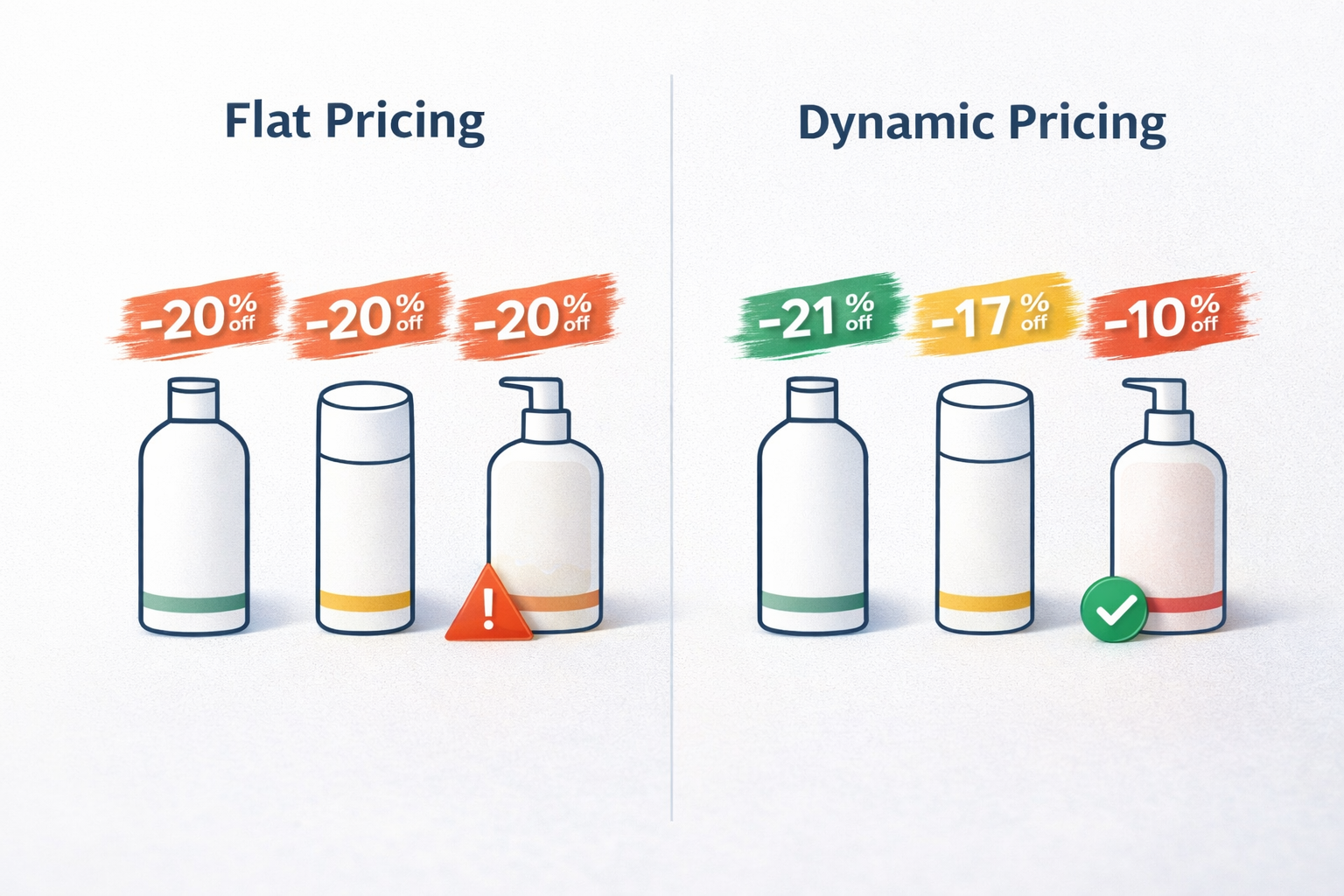
If you apply a flat 20% bundle discount, the bundle sells for $75.20. That's $18.80 off the total. But where does that discount come from?
With flat pricing, it comes proportionally from everywhere, including your moisturizer where you only had 57% margin to begin with.
With dynamic pricing, you could structure it like this:
Product
Bundle price
Discount
Cleanser
$22
21% off
Toner
$20
17% off
Moisturizer
$38
10% off
Bundle total: $80
Same perceived value to the customer ($14 off), but you've protected margin on the product where you needed it most. Your cleanser absorbs more of the discount because you have room there. Your moisturizer stays closer to full price.
What to know before you enable dynamic pricing
Every pricing strategy comes with pros and cons, and dynamic pricing is no different:
Pricing lives in Simple Bundles. Once you enable dynamic pricing, your bundle item prices are managed in the app. If you update prices in Shopify directly, those changes won't sync to your bundles. Make all pricing changes in Simple Bundles.
No CSV import/export. If you manage large catalogs via spreadsheet, dynamic pricing bundles can't be bulk-edited this way. You'll need to adjust prices in the app.
Shopify Markets price lists don't apply. If you use Shopify Markets with different price lists for different regions, dynamic pricing won't pull from those lists. It uses the prices you set in Simple Bundles.
Nested bundles aren't supported. If your bundle contains another bundle, dynamic pricing won't work for that structure.
For most merchants, these limitations are minor. But if you rely heavily on CSV workflows or Shopify Markets, factor that into your decision.
Making the call
If your bundles include products with similar margins, flat pricing is simpler and works fine. But if you're bundling a mix of high-margin and low-margin items, dynamic pricing gives you the control to protect your profits while still offering customers a compelling deal.
Start with one bundle. Set individual prices based on what each product's margin can support. Test it for a few weeks and compare your margin per bundle against the flat-pricing approach.
That's the move.
Build a bundle in under 5 minutes
Over 25,000 Shopify merchants use Simple Bundles to sell more per order.
Product bundle pricing is one of the most effective ways to increase average order value. This guide explores the psychology and economics behind successful bundling, including why bundles increase perceived value, how top brands structure their offers, and the pricing frameworks that drive results.
This guide breaks down how Shopify POS bundles actually work, the limitations of native bundling, and how growing brands create flexible bundle experiences with real-time inventory syncing and smooth in-store checkout flows.
The article walks through a four-step setup framework, including SKU mapping, automatic inventory syncing, and order testing, while also sharing conversion best practices to help three-pack bundles increase AOV and drive more sales.